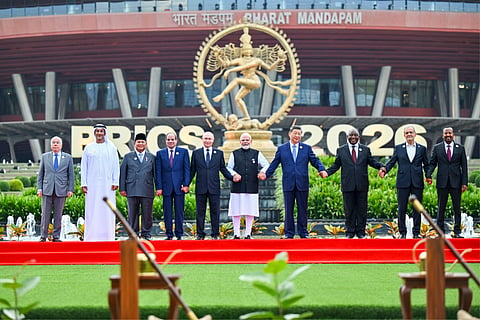

When leaders of the BRICS countries gathered in New Delhi this week, the group was very different from the one India first hosted in 2012. What began as a four-country grouping of Brazil, Russia, India and China has expanded to 11 members and 10 partner countries, bringing in major economies and energy producers from Africa, the Middle East and Southeast Asia. Collectively, the expanded BRICS now represents almost half the world's population, around 40 percent of global GDP and more than a quarter of global trade.
The setting could hardly have been more complicated. The global economy is fragmenting, trade tensions have intensified, wars continue to disrupt energy and supply chains, and confidence in established multilateral institutions has weakened. At the same time, the developing world is demanding greater voice in institutions whose structures often reflect the economic realities of a very different era.
It is against this backdrop that the New Delhi Declaration should be read. Its significance lies less in any single sentence than in what the whole 140-point document reveals about the evolution of BRICS. It is no longer simply an economic grouping seeking a larger voice. It is becoming an increasingly important platform for cooperation on trade, finance, technology, development, climate, energy, health, agriculture, infrastructure and global governance.
That is an achievement. But it also presents BRICS with its central challenge: can a grouping that has become so large and diverse convert its growing relevance into collective influence?
From Representation to Reform
The strongest theme running through the Declaration is the demand for a more representative international order.
BRICS calls for greater participation of emerging and developing economies in global decision-making and for more equitable geographical representation in international institutions. It specifically highlights the under-representation of developing countries at senior levels of the UN system and calls for more transparent and inclusive processes for selecting its leadership.This is not merely rhetoric. The international economic and political weight of emerging economies has changed dramatically since many of today's institutions were created. Yet their representation has not always changed at the same pace.
The Declaration therefore gets an important thing right: the argument for reform does not have to be an argument against multilateralism. BRICS repeatedly reaffirms the centrality of the United Nations, international law and multilateral cooperation. Its proposition is essentially that multilateralism will remain legitimate only if it becomes more representative.That is a more constructive proposition than portraying BRICS as an alternative to the existing international system.
India's position has been particularly important here. New Delhi has consistently argued that BRICS should not become an anti-Western bloc but should instead help make global governance more representative. That distinction matters because the expanded BRICS contains countries with very different political systems, strategic interests and relationships with the West.
The economics may matter more than the geopolitics
The Declaration's economic sections are arguably more consequential than some of its geopolitical language.
On trade, BRICS reaffirms the centrality of the WTO, supports a rules-based and predictable trading system and calls for reform of the organisation, including restoration of a functioning dispute-settlement system. It also addresses a more practical challenge: enabling developing countries to move into higher-value segments of global value chains through trade, investment, technology transfer and productive capacity.This is significant.
For many developing countries, the objective is not simply to export more commodities. It is to manufacture more, add more value and participate in the technologies and supply chains that will define the next phase of global growth.
The Declaration's focus on MSMEs is therefore particularly welcome. It recognises access to affordable finance as a major obstacle to internationalisation and supports innovative mechanisms to improve trade finance, including work towards an invoice-discounting mechanism for BRICS members.These may sound like technical measures. They are not. If implemented, they could matter considerably more to businesses than another high-level declaration about South-South cooperation.
The same is true of the BRICS agenda on payments. Members are exploring interoperability among payment and messaging systems and greater use of local currencies for trade and investment. But the Declaration is careful to acknowledge that there is no single model suitable for everyone.This is progress, but it should not be exaggerated. BRICS has not created a common currency or a fully integrated alternative payments architecture. The more realistic achievement is the gradual construction of mechanisms that can make cross-border trade less vulnerable to disruptions in existing financial channels.
The New Development Bank: The institution to watch
If there is one BRICS institution capable of converting political ambition into tangible outcomes, it is the New Development Bank.The Declaration calls for the NDB to expand its capacity to mobilise resources, increase local-currency financing, diversify its funding sources and support infrastructure, sustainable development and economic integration. It also supports expanding the Bank's membership and strengthening its institutional resilience.This is where BRICS has an opportunity to move beyond declarations.
Infrastructure deficits remain one of the principal constraints on development across the Global South. The financing requirements are enormous, while many developing countries face high borrowing costs and constrained fiscal space. A stronger NDB, working alongside national and regional institutions, could help address precisely this gap.
The same logic lies behind the proposed BRICS multilateral guarantees initiative, which seeks to mobilise private capital and reduce financing costs for development projects. But here the Declaration also reveals the distance still to be travelled: the initiative remains at the stage of technical work and development of pilot transactions.
That distinction - between an agreed direction and an operational instrument - runs through much of the Declaration.
Technology may be BRICS' most under-appreciated opportunity
One of the most forward-looking aspects of the Declaration is its treatment of technology.Artificial intelligence, digital public infrastructure, cybersecurity, quantum technologies, digital connectivity and science cooperation feature prominently. The Declaration recognises AI as a potential driver of growth and development while stressing safety, accessibility, inclusiveness and reliability. It also commits members to implementing the BRICS Leaders' Statement on global AI governance.
The developing world should not merely be a consumer of technologies designed elsewhere. It has a stake in shaping the rules, standards and applications of technologies that will increasingly determine productivity, public services and economic competitiveness.
Here, India's experience with digital public infrastructure gives it a distinctive contribution to make. The Declaration's emphasis on digital connectivity, capacity building and knowledge sharing provides a framework within which such experiences can be shared across the Global South. But once again, the test will be implementation.
Climate and energy: development cannot be separated from transition
The Declaration's climate agenda is similarly pragmatic.It reaffirms the Paris Agreement and the principle of common but differentiated responsibilities, but also places adaptation, climate finance, technology transfer and developing-country debt constraints firmly on the agenda. It opposes unilateral and punitive climate measures such as carbon border adjustment mechanisms, arguing that they can place additional burdens on developing countries.
The underlying message is important; namely that energy transition cannot be divorced from the development transition.
For countries still expanding their energy systems, the objective must be simultaneously to reduce emissions, improve energy security, maintain affordability and create new industrial opportunities. That requires renewable energy, but also grids, storage, finance, technology, critical-mineral supply chains and resilient infrastructure.
BRICS is particularly well positioned to address this because its members include major producers and consumers of energy as well as some of the world's largest renewable-energy markets.The opportunity is therefore not simply to consume green technologies but to manufacture them, finance them and develop the supply chains around them.
Where the Declaration falls short
Yet it would be a mistake to read the New Delhi Declaration as evidence that BRICS has suddenly become a cohesive geopolitical force. Its greatest strength - its diversity - is also its greatest weakness.
The interests of Brazil, China, India, Russia, South Africa, Iran, the Gulf members, Egypt, Ethiopia and Indonesia do not automatically converge. Their relationships with the United States, Europe and one another differ significantly. Their economic structures and foreign-policy priorities are equally diverse. That makes consensus impressive when it occurs, but it also explains why so much of the Declaration is expressed through words such as "welcome", "encourage", "support", "explore" and "look forward".
The financial architecture is a good example. BRICS is discussing payments, investment platforms, insurance cooperation, guarantees and settlement infrastructure. But many of these remain technical or exploratory initiatives rather than functioning common institutions.
The same limitation applies to geopolitics.The Declaration calls for restraint, dialogue, diplomacy, respect for sovereignty and international law in addressing conflicts. Given the extraordinary geopolitical tensions surrounding this year's summit, achieving consensus among 11 members was itself significant. The declaration's call for maximum restraint over the Middle East conflict is particularly notable given the presence of both Iran and the UAE within BRICS.
But BRICS has yet to demonstrate that it can collectively resolve major international crises.That is an important distinction. Being a forum for diplomacy is not the same as being an instrument of diplomacy.
The real test will begin after the Summit
The New Delhi Declaration should therefore neither be dismissed as another diplomatic communiqué nor celebrated as the arrival of a new global order.It is something more interesting.
It shows that BRICS has developed an increasingly substantial architecture of cooperation. Its agenda now reaches deeply into the practical questions that will shape the next decades: who finances development, who writes technology standards, how global value chains are organised, how energy transitions are financed, how emerging economies participate in global governance and how international institutions adapt to a changing distribution of economic power.
India's Chairmanship has helped push the grouping in precisely this direction. The stated themes - resilience, innovation, cooperation and sustainability - is reflected across the Declaration and in the extensive programme of meetings and initiatives conducted during the year. More than 400 meetings and engagements across 30 Indian cities brought ministers, officials, businesses, experts and civil society into the BRICS process.That is a considerable institutional achievement.
But the next phase cannot be measured by the number of meetings or paragraphs in declarations. It must be measured by outcomes: more trade, cheaper finance, functioning payment mechanisms, greater investment, stronger value chains, practical technology partnerships, better infrastructure and a greater voice for developing countries in global institutions.At 20, BRICS has clearly outgrown its original acronym.
Its future relevance will not be determined by whether it becomes an anti-Western alliance; in fact it doesn’t need to. Nor is it likely to become a tightly integrated economic bloc. Its more plausible and potentially more valuable role is as a platform through which the world's emerging economies can collectively shape, rather than merely react to, the rules of a changing international system.
That is an ambitious proposition. But the New Delhi Declaration suggests that the foundations are beginning to exist.The real test is whether BRICS can now turn those foundations into results.
(The author is President, Chintan Research Foundation & former Director, WTO. The views are personal)
