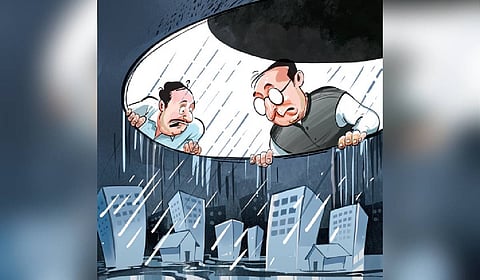

As the monsoons hit parts of India, citizens brace for yet another nightmare that turns everyday existence into a swamp of misery, danger and utter humiliation. What should be a season of renewal instead unleashes miseries and mayhem. Streets transform into filthy rivers, drains vomit sewage onto roads, live wires dangle like death traps, footpaths vanish under hawkers and rubble, garbage piles fester into mountains, and illegal concrete monsters sprout overnight.
This is not nature’s fury alone. It’s the predictable, man-made catastrophe born of corruption, indifference and criminal neglect by those sworn to serve. It’s an annual festival of fatalities caused by failures on all fronts. India has been pushed into an engineered paralysis.
India’s urban landscape is governed by more than 250 municipal corporations and thousands of municipal councils and nagar panchayats. These bodies—bloated with babus, contractors and politicians locked in a rotten nexus—have presided over the systematic collapse of civic life. Every monsoon exposes their failure with brutal clarity.
Consider the deluges that have become annual rituals. In 2005, Mumbai’s streets swallowed more than 1,000 lives as the Mithi river and silted drains failed spectacularly. Chennai in 2015 saw three-fourths of the city submerged, displacing over 500,000 people amid choked waterways and vanished wetlands. Delhi, Bengaluru, Hyderabad and countless tier-2 cities repeat the horror yearly—water-logging that electrocutes pedestrians, stalls traffic for days and turns homes into cesspools. Major drains in Mumbai, Chennai and Delhi lie completely silted, their desilting either botched or abandoned.
Newly-laid “world-class” roads crack within months, victims of substandard material, kickbacks and zero maintenance. Traffic in tier-2 cities has become a daily apocalypse. Poor road engineering narrow lanes, missing signals, chaotic junctions combined with lazy, bribe-hungry traffic police creates gridlocks that devour hours and fuel.
Ambulances crawl while patients die. The stench of failure hangs everywhere. Piling garbage chokes roads and pavements because municipal agencies have no scalable solution for waste amid a real-estate boom that spews construction debris and household refuse.
The Swachh Bharat Mission, once hailed as transformative, lies in tatters. Celebrity ambassadors and local volunteers have vanished. Landfills in major cities remain uncleared in many cases; segregation is inconsistent; processing claims mask overflowing dumps and toxic leachate. Big cities routinely rank poorly in cleanliness surveys. Foreign visitors increasingly skip India or cut short trips, repelled by the filth that greets them at airports and follows them everywhere.
The Smart Cities Mission, meant to revolutionise 100 urban centres with modern infrastructure and technology, has been all but forgotten. After extensions and over Rs 1.5 lakh crore used by early 2025 across thousands of projects, only a handful of cities achieved anything close to transformation.
Data from the Council for Active Mobility shows that only 9-20 percent of footpaths in major Indian cities meet official standards. Vast majorities are encroached by hawkers, illegal parking, shops and debris. Illegal construction is the cancer eating our cities alive. Far more unauthorised buildings rise every year than approved ones in many cities. They violate every fire-safety norm, lack emergency exits and proper structural integrity.
In Delhi alone, the municipal corporation booked 4,766 unauthorised constructions in 2025 and issued thousands of demolition orders. Nationwide, structural collapses linked to illegal or substandard buildings have caused thousands of deaths in recent years. Fire accidents tell an even grimmer tale: in 2024, the National Crime Records Bureau recorded 5,971 fire accidents that claimed 5,888 lives—nearly 16 deaths every single day.
Authorities wake up for a few days of token action after each tragedy and then slip back into slumber. The nexus between babus, contractors and politicians ensures violators escape with nominal fines or political protection. At the rotting core of this national disgrace stands the highly-protected Indian bureaucracy—the IAS officers, state civil servants and municipal commissioners who enjoy near-impenetrable job security under service rules that render dismissal virtually impossible even for gross negligence or corruption. These mandarins, cocooned in their air-conditioned offices and fortified by Article 311 protections, routinely receive promotions, foreign postings, gubernatorial sinecures and fat pensions while the cities they were meant to serve degenerate into open sewers.
They sign off on illegal constructions that violate every safety code, ignore decades of silt accumulation in critical drains, rubber-stamp shoddy road projects that collapse in the first monsoon, and preside over the criminal mismanagement of garbage and footpath encroachments.
While citizens drown in sewage, get electrocuted on flooded roads and lose loved ones in building fires, these bureaucrats climb the career ladder with clockwork regularity, collecting salaries, perks and assured retirement benefits as if the rotting infrastructure were someone else’s problem. Even official reports have exposed the pathetic conditions of Indian cities. According to an assessment of 4,589 urban local bodies done under Swachh Survekshan, 3,642 including Greater Mumbai and Bengaluru scored zero out of 1,300 allocated for the garbage-free city metric.
They thrive on the very decay they create. They are fully protected by both the rules and the political rulers. While the civic agencies and the protected bureaucracy have failed the nation, ordinary Indians are equally responsible for making India dirty and chaotic.
They keep their homes spotlessly clean, yet casually throw garbage on roads, indulge in illegal construction, encroach upon pavements and drains. Even NGOs engaged in promoting green and clean India spend more time of promoting technologies and products than guiding the citizens to about cleanliness.
Citizens cannot demand accountability from the system while they themselves perpetuate filth, chaos and corruption through their own actions. A total, uncompromising ban on illegal construction must be enforced with immediate demolitions and criminal prosecutions. Long-term jail terms, not fines, for violators, builders, complicit officials and politicians must be put in place. Civic engineers and municipal officers who enable encroachments or approve unsafe structures must face dismissal, blacklisting and prosecution. The Centre must impose binding model civic plans on all states, with real-time monitoring and funding linked to performance. The toxic nexus must be shattered through independent oversight, asset disclosures, swift transfers and exemplary punishment.
Both the authorities and the citizens must face ruthless accountability. Without radical, immediate action, India risks being branded as the dirtiest major nation. Indian cities are drowning literally and figuratively. The monsoons will return. The question is whether India will finally wake up before the next body count rises. The time for excuses is over. The time for ruthless accountability is now.
Read all columns by Prabhu Chawla
prabhu chawla
prabhuchawla@newindianexpress.com
Follow him on X @PrabhuChawla
