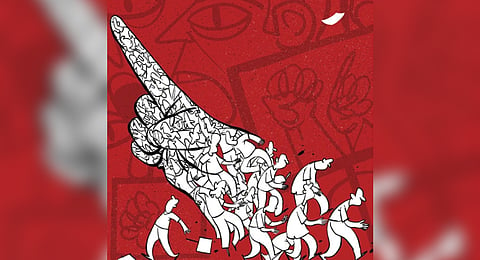

There was a time when governments feared the street almost as much as they feared the ballot. Ram Lila Maidan or Jantar Mantar in Delhi, Shivaji Park in Mumbai and Marina Beach in Chennai were not merely public spaces. They were democratic theatres where public anger acquired political legitimacy. A gathering at any one of these venues could alter the national conversation, unsettle governments and compel those in power to listen. Those landmarks remain where they always were. What seems to have disappeared is the citizen’s willingness to occupy them.
The prolonged agitation over paper leaks and electoral issues, later joined by Sonam Wangchuk, has once again drawn attention to this curious transformation. Despite weeks of protest, hunger strikes and expressions of solidarity from sections of the opposition, the movement has struggled to attract the spontaneous participation that once turned a grievance into a national movement. The silence has been striking. Civil society has remained hesitant, public intellectuals have largely stayed away and even those who routinely express outrage on television and social media have shown little inclination to translate indignation into physical participation.
Is this merely the failure of yet another protest? Or does it reflect a deeper alteration in the character of Indian democracy? The paradox is difficult to ignore. India has no shortage of issues capable of provoking public anger. Farmers continue to complain about uncertainty. Young people remain anxious over exams and employment. Allegations of corruption continue to surface. Political discourse has rarely been more polarised. Yet none of these grievances has produced the kind of sustained, nationwide mobilisation that earlier generations regarded as almost instinctive.
Why have the streets fallen silent while public discontent appears alive in every other sphere? Has dissent migrated from the public square to the digital screen? Or has India entered a phase where democracy is increasingly negotiated through elections and social media rather than through collective public action or a discourse?
Technology has unquestionably altered the grammar of politics. Earlier generations marched with banners; today’s generation brandishes smart phones. A hash tag can travel farther than a procession and a short video often reaches more people than a public meeting. Digital platforms have democratised expression in ways unimaginable a decade ago. Yet visibility should not be confused with mobilisation. Governments may find online criticism inconvenient, but disciplined public mobilisation has historically posed a far greater democratic challenge.
Economic change may have contributed to this behavioural transformation. India has become more aspirational than aggrieved. The expanding middle class is understandably preoccupied with careers, education, business and economic advancement. Agitation carries a cost. It consumes time, creates uncertainty and occasionally invites confrontation. Prosperity often moderates political behaviour, but has it also weakened the instinct for organised public action?
The behaviour of the younger generation presents another puzzle. They face intense competition, uncertain employment and enormous professional pressure. Logic would suggest that they possess compelling reasons to organise and protest. Yet university campuses seldom display the ideological ferment that once shaped national politics. Student unions have lost much of their earlier influence. It seems idealism has yielded to individual ambition and politics itself has ceased to inspire confidence.
Quality and credibility of the current leadership is under close scrutiny too. Every successful public movement has possessed a moral centre that transcended party politics. Mahatma Gandhi transformed resistance into an ethical mission. Jayaprakash Narayan converted political dissatisfaction into a democratic crusade. Anna Hazare succeeded, however briefly, because millions viewed his campaign as a moral intervention rather than a partisan exercise. Contemporary movements often struggle to establish that distinction.
Equally important is the continuing political dominance of Prime Minister Narendra Modi. His communication skills, welfare programmes and personal appeal have enabled him to retain the confidence of large sections of the electorate despite criticism over individual policies. Many citizens who disagree with specific decisions remain unconvinced that a more persuasive national alternative has yet emerged.
Democracies function not only on dissatisfaction with those in power but also on confidence in those seeking to replace them. Perhaps this changing reality explains why Rahul Gandhi increasingly prefers direct engagement with students, farmers, workers and local communities instead of relying exclusively on massive demonstrations in the national capital.
The relative withdrawal of civil society is equally significant. There was a time when retired judges, former civil servants, academics, writers and artists gave public movements intellectual legitimacy and moral weight. Their presence reassured ordinary citizens that a cause extended beyond partisan calculations. Today, many appear reluctant to occupy that space. Whether this reflects fatigue, caution, increasing polarisation or diminishing public confidence is open to debate, but the consequence is unmistakable. Protest movements now struggle to acquire the broad social coalition that once sustained them.
It doesn’t necessarily mean that Indians have become politically indifferent. Electoral participation remains impressive, political debate flourishes across every medium and citizens continue to scrutinise governments with remarkable intensity. The energy of democracy has not disappeared. It has merely changed its expression. Voting remains democracy’s foundation, but elections alone cannot become the only conversation between citizens and governments. Peaceful protest remains an equally legitimate democratic instrument because it reminds those in office that electoral victory is not a licence to stop listening.
That is why the diminishing resonance of India’s protest culture deserves wider reflection than the success or failure of any individual agitation. A government may welcome quieter streets. An opposition may lament the absence of mobilisation. Yet the larger issue belongs to neither. Democracies gradually lose an important corrective when citizens begin to doubt that collective action can influence public policy.
Perhaps every explanation contains part of the truth. Technology has changed behaviour. Economic aspiration has altered priorities. Political leadership has reshaped electoral calculations. Civil society has become more fragmented and the opposition has struggled to inspire confidence. Yet one question still lingers above all the others. Have Indians begun to lose faith in their own power standing together peacefully, to persuade governments to pause, reflect and respond? If that faith is indeed diminishing, the issue extends well beyond one agitation or one political party. It touches the very character of democratic partnership.
Democracies do not become fragile only when institutions weaken. They also become vulnerable when citizens retreat from the public square, convinced that their presence no longer matters. India has certainly not run out of grievances. The more unsettling question is whether it is gradually running out of trusted leaders who are prepared to transform those grievances into a collective democratic voice.
Read all columns by Prabhu Chawla
Prabhu Chawla
prabhuchawla@newindianexpress.com
Follow him on X @PrabhuChawla
