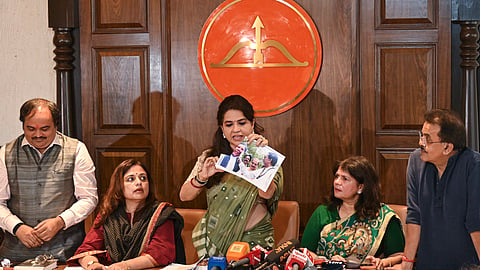

Politicians tearing up or burning books in public is a threat dressed up as protest. The real audience is the author whose work has displeased power. A book is many things to civilisation: a living deposit of history, an interrogation of present values and an invitation to examine the future as the author sees it. It does not require permission to enter the minds of its readers. And the mind is power’s greatest enemy.
The relevance of books is rarely about paper and ink. It is the idea that offends, or makes insecure, thin-skinned authorities and poorly literate leaders who wish to control what society is permitted to absorb, what it is allowed to question and which thoughts must be feared.
One may disagree with an author’s account of a character, question the interpretation of a historical personality, or challenge the accuracy of particular passages; but these are perfectly legitimate responses to a published work. Tearing up a book at a political event is not a literary review.
Authors, especially biographers, take sides, as we all do. They interpret history through their own experiences, prejudices, convictions and political affiliations. Memoirs become subjective documents containing revelations, omissions, personal grievances, interpretations and sometimes even uncomfortable truths.
These claims certainly deserve scrutiny, inaccuracies deserve correction and conclusions can be challenged by historians, writers and witnesses. No memoir is beyond criticism simply because it is written by a prominent person. On the other side, the author cannot offer a version of history to please every political constituency. The politician who destroys a book in front of TV cameras is warning every aspiring writer, publisher, academic, journalist and historian to think twice before approaching a politically sensitive subject.
History offers many instructive episodes. In Renaissance Florence, on February 7, 1497, the Dominican friar Girolamo Savonarola organised the Bonfire of the Vanities, consigning books, paintings, musical instruments, cosmetics, fine clothes and even mirrors to a great public bonfire in the Piazza della Signoria.
Objects were judged not on their artistic or intellectual merit but on whether they conformed to the official conception of religious virtue. In 213 BCE, the Chinese emperor Qin Shi Huang ordered the destruction of books dealing with history and philosophy to eliminate contrary intellectual traditions and consolidate imperial authority. The repeated destruction of the Library of Alexandria over centuries remains one of the great tragedies of the ancient world.
The Mongol sack of Baghdad in 1258 CE devastated a major centre of learning. In Europe, the Catholic church’s Index Librorum Prohibitorum, first published in 1559, institutionalised the prohibition of books considered dangerous to religious doctrine or moral authority. Islamists burn everything in their path, believing the Koran is the only book that should exist.
John Milton, in his 1644 pamphlet Areopagitica, condemned the licensing of publications in England: “Give me the liberty to know, to utter, and to argue freely according to conscience, above all liberties.” That was nearly four centuries ago, but his point remains relevant. On May 10, 1933, the Nazis publicly burned thousands of books by Jewish writers, Marxists, liberals, pacifists and intellectuals considered hostile to Hitler’s ideology.
The warning of the German poet Heinrich Heine was stark: “Where they burn books, they will ultimately burn people too.” During China’s Cultural Revolution, books and cultural artefacts considered incompatible with Maoist ideology were destroyed. In 1981, a Sinhalese mob burned down the Jaffna Public Library in Sri Lanka, which housed some 100,000 Tamil books, manuscripts and historical documents.
In 2012-13, Islamist militants set fire to ancient manuscripts in Timbuktu, Mali, although local librarians and residents managed to rescue hundreds of thousands of them. India, too, has its history of book bans and literary controversy. In 1988, the Rajiv Gandhi government prohibited the import of Salman Rushdie’s The Satanic Verses, making India the first country to do so.
Article 19(2) of the Indian Constitution permits reasonable restrictions on freedom of expression on specified grounds, including the sovereignty and integrity of India, the security of the State, friendly relations with foreign states, public order, decency or morality, contempt of court, defamation and incitement to offence—”reasonable” being the significant word.
Destroying a printed copy of a book is self-defeating, since the book itself is not destroyed: thousands of other copies will be available in digital editions and in libraries around the world. A public destruction actually produces the opposite effect, drawing attention to a work that might otherwise have received considerably less notice. The political spectacle gets publicity, but it does not establish the intellectual invalidity of the book.
The difference between information and knowledge is not a new trope. Information supplies facts, accounts and particulars which, when examined, interpreted, contested and placed in context, become knowledge. A society may be flooded with information and yet remain profoundly ignorant if it loses the freedom to question. Books are among the oldest and most durable instruments through which information becomes knowledge. To attack them is to attack the process by which a society learns to think for itself.
Perhaps the most useful way to judge a democracy is not by how enthusiastically it celebrates books that flatter the establishment, but by how comfortably it accommodates works that challenge it. A society confident in its own history should not be frightened by a memoir. A political movement confident in its heroes should not feel threatened by a different interpretation. The pages torn in Mumbai are replaceable. But any authority, irrespective of political affiliation, that begins to fear books is in reality fearing the questions that keep civilisation alive.
Read all columns by Ravi Shankar
Ravi Shankar
Editor
Follow him X at @etteth
