
India runs on many calendars. The fiscal calendar defines the spend of the exchequer, the academic year for students, the kharif and rabi calendars for farmers, the festival calendar for the soul. There is a fifth calendar that is unprinted and unfailing, observed with the devotion of the faithful. It is the calendar of outrage.
It opens with January and February focused on air pollution. This January, 123 of 148 cities recorded higher-than-recommended PM2.5 levels, and 53 cities figured in the most polluted lists. March arrives with water worries. Taps run dry and tanker mafias rule the roost in Bengaluru, Chennai, Mumbai, Pune. By May, it is inverter raj as power outages haunt homes and offices. June brings the rains; July brings the floods. The clouds clear for potholes and craters to show up in August and September. October is open for suggestions, followed by November and December, when the nation returns to smog, stubble burning, winter inversion. Between the recurring surprises, there is the parade of preventable disasters—hotels and hospitals on fire, collapsing flyovers, derailed trains, stampedes at shrines and attacks on hospitals.
The disasters arrive without appointment, but rarely without precedent. The rituals that follow events are as predictable. The visuals surface on social media followed by headlines. Whether the government follows depends on the math of casualties and momentum of opposition—and is usually followed by announcements. This year when the 50 hottest cities of the planet were in India, the minister stayed in the shade and mum.
Explanations for events sound more like alibis—“this much rain was not expected”. It is also the only time climate change is acknowledged. Nature is ahead of the curve, governance is behind it—and the distance between the two is measured in committee reports that are old enough to vote and are still waiting to be read. The unprecedented has become India’s most precedent justification.
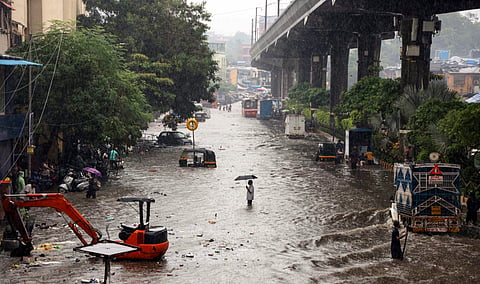
The response to events is predictable. So is the follow up. After the catastrophe in Mumbai in 2005, the Madhav Chitale committee delivered a 359-page report. Twenty years later, its core prescriptions—no development zones along rivers, relocation of encroachments, mangrove protection—remain largely unimplemented. In 2018, a Supreme Court-appointed committee reported on the lack of effective steps and that even the 50-metre buffer had not been created. This week, Mumbai and Pune were inundated by flood waters for over 48 hours at places, bringing the cities to a standstill.
Mumbai presents the template for unattended issues. Following a major flood in 1985, a committee identified the need for a new stormwater drainage system. In 1993, the BMC came up with the Brihan Mumbai Storm Water Disposal System, but didn’t implement it for lack of funds. BRIMSTOWAD surfaced again after the 2005 floods, but is incomplete in 2026. On Thursday, the Maharashtra government announced yet another plan that will cost over Rs 13,000 crore and which will make Mumbai “a sponge city”.
The archives damn governments. This week, Surat received the heaviest rainfall in its history. Its vulnerabilities though are not new, though. The recommendations for solution date back several decades to after the 1968 floods. The expert panel which examined the 2006 floods indicted the construction sprawl on Tapi’s flood plains. Two decades later, the floodwaters followed the construction sprawl. The response: announcement of a `500-crore project.
Bengaluru and Chennai have refined the absurdity of circumstance. Both face water distress and often ration water by tankers in April. They also end up evacuating people by boat in November. Chennai 2015 followed a drought; Bengaluru’s 2022 floods arrived months after its borewells ran dry. Same lakebeds—concretised for shortage, submerged in surplus. In Delhi, the government declared the waterlogging “under control” the same afternoon the opposition declared that the capital a sea. In 2024, a landslide in Kerala’s Wayanad district buried over 400 people. This week, another landslide struck Kalladi in the same district. The hillside was mapped, vulnerability documented, warnings issued.
On paper, India is a global superpower of committees. The Rashtriya Barh Aayog (National Commission on Floods) was constituted in 1976. It submitted 207 recommendations that were sent to states in 1981. But the recommendations stayed on paper. In 2001, the Rangachari Committee reviewed and shortlisted 40 recommendations for immediate implementation. Guidelines followed disasters. The National Disaster Management Authority’s guidelines came in 2010. The BJP’s promise of 100 new cities in 2014 were followed by Smart Cities and the AMRUT programme. Yet, on ground, there is little to assure people.
India does not lack for diagnosis. But it suffers from a 20-year lag between the diagnosis and implementation. Consider this nugget. In 1975, the Union government drafted a model law for flood plain zoning and shared it with the states. Suffice to say it did not get far. But in 2022, the idea was back in circulation. And in 2026, it is stranded between the Centre and the states. Unlike in the past, weather updates are fairly robust these days. The warnings land. The orange alerts are issued. What does not exist is the machinery to act on foresight—because the entire apparatus of Indian administration is trained to react, not prevent.
Tolstoy observed that happy families are all alike, while each unhappy family is unhappy in its own way. Indian cities are unhappy for the same reasons, only on different schedules. Different rivers, identical post-mortems. Encroached flood plains. Concretised lakebeds. Desilting claims disproven at the first cloudburst. The calendar of outrage will keep its appointments. The question is whether governments will keep their appointment with governance.
Read all columns by Shankkar Aiyar
The Third Eye / Shankkar Aiyar
Author of The Gated Republic, Aadhaar: A Biometric History of India’s 12 Digit Revolution, and Accidental India
(shankkar.aiyar@gmail.com)
