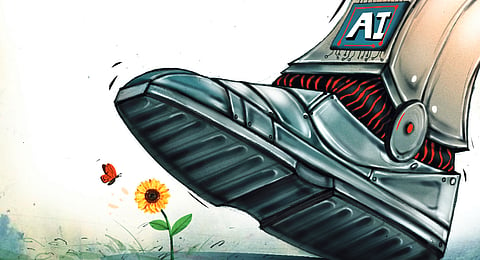

The world is increasingly being illuminated on split screens. One shows the surge of moonshots—of technology, market valuations and capital. The other reveals how those moonshots are tripping tech hiring in India and across the world.
This Thursday, events and headlines split across two screens. On the first screen, you saw earnings of IT companies, billions committed to data centres and agentic artificial intelligence, the buzz of AI-linked revenues and bullish analyst calls. The second screen, seemingly mute, revealed shrinking headcounts, hiring sliding to a two-year low and a quiet decoupling of revenue from employment.
These are stories viewed from different sides of the economy. Check the first screen. The analyst calls were riveted by two alphabets—A & I. TCS, HCL Tech, Wipro and Tech Mahindra posted rising revenues, strong order books and a surge in AI-related earnings. The hurrahs drowned a reality. Rupee revenues did grow in double-digits, topping 14 percent at some firms. But much of that gain was propped up by rupee depreciation. Strip out the exchange-rate effect, and constant-currency revenue growth dips to roughly 1-6 percent, depending on the company.
Now check the second screen. On the face of it, TCS added around 9,000 employees this quarter, but the total headcount of 5.93 lakh is still lower than the 6.13 lakh recorded a year ago. Wipro—which says ‘AI is evolving faster than ever’—announced it will not hire fresh engineering graduates this year. Tech Mahindra's headcount stands at 1.46 lakh, down from a year ago; HCL Tech's is down by 3,200. If one merges the two screens one could produce an arbitrage index—growth minus headcount growth.
India's tech outfits are placing their bets in plain sight. Capital is flowing towards AI at unprecedented speed. Availability of labour, once the defining competitive advantage, is no longer a necessary condition for growth. For three decades, the model was 'more people do the work for less money'. That model is being dismantled. In five days of earnings announcements, Indian IT published the blueprint of its next business model: invest heavily in machines, hire cautiously, trim headcount.
The demand side signals spell it out. The June report of talent solutions company Xpheno reveals active tech job openings fell to the lowest in 28 months in June, with entry-level demand down 44 percent and senior openings down 67 percent year-on-year. The gates are narrowing at both ends of the career.
The AI effect is visible in another window—filings by Indian companies with governments in the US under the Worker Adjustment and Retraining Notification (WARN) Act of 1988 and in independent recruiter data. The June 2026 Challenger report reveals that over 14,000 AI-related job cuts were announced in the month. This year, AI has been cited as the reason for 1,01,743 job cut announcements, which account for nearly a quarter of all the announced job cuts till now.
Context is critical for comprehension. Automation in global markets triggers retrenchment in Indian offices. Deployment of AI in Palo Alto triggers pink slips in Pune. Microsoft CEO Satya Nadella said that AI was writing 30 percent of the code. It is claimed that over 50 percent of the code in Tencent and over 40 percent in Baidu and Alibaba Cloud is written by AI; it goes up to as much as 90 percent of the code at Meituan!
Oracle revealed reduction of 21,000 jobs in its annual filings citing AI deployment. Salesforce CEO Marc Benioff deployed AI Agentforce, which handles half the company's service calls, and cut over 4,000 jobs. When companies report that AI writes the bulk of new code, it means billable hours and costs come down, accelerating automation.
Ernest Hemingway wrote that bankruptcy happens "gradually, then suddenly". So do technological revolutions. Thursday’s unveiling of Moonshot AI's Kimi K3 suggests AI may have reached one of Hemingway's 'sudden' moments. The launch of Kimi K3—a 2.8-trillion-parameters system, claimed to be the world's largest open-weight AI model—is described as a structural shift in the AI ecosystem, as it promises to deliver outcomes matching US giants at a fraction of the cost.
On the AI row are DeepSeek, the Hangzhou startup whose R1 model wiped billions off US tech stocks and which is reportedly developing its own chip, and SenseTime's 600-billion-parameter multi-modal model SenseNova, which is offering API access at about eight US cents per million tokens. If frontier-class intelligence can indeed be delivered at a fraction of today's cost, adoption will accelerate the dismantling of existing business models. To appreciate, juxtapose what China did for goods to what it threatens to do in services.
This is a macro story, not a sectoral one. IT services is India's largest exporter, largest employer and a force multiplier of consumption in the economy. The arbitrage that built a middle class is being repriced in public, quarter by audited quarter. The challenge before governments is to redesign the employment model. The split screen will not remain split forever. The real economic consequences of the AI revolution will be visible and become impossible to ignore.
F Scott Fitzgerald defined a first-rate intelligence as the ability to "hold two opposed ideas in the mind at the same time" and still function. Governments in India and elsewhere now face the harder version of the test: to empower machines without disempowering people. Their task is to leverage machines to upskill people and fund the machines without defunding the people.
Read all columns by Shankkar Aiyar
Shankkar Aiyar | Author of The Gated Republic, Aadhaar: A Biometric History of India’s 12 Digit Revolution, and Accidental India
(shankkar.aiyar@gmail.com)
