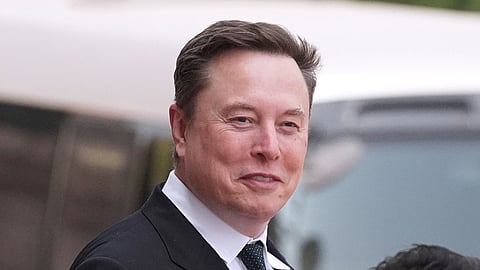

On Thursday evening, he was worth $696 billion. Roughly 12 hours later, as SpaceX listed on Nasdaq, mercurial genius Elon Musk notched history’s milestone—the world’s first trillionaire. A trillion is eleven digits long. I asked @Grok how long it would take to spend it. The answer: 31,710 years, three times longer than recorded human civilisation.
Warren Buffett observed that neither he nor anyone else could have dreamt of the fortunes now attainable. “It has been mind-blowing—beyond the imaginations of Ford, Carnegie, Morgan or even Rockefeller. Billions became the new millions.” A trillion, it would seem, is the new billion.
SpaceX clocked $2.1 trillion in market cap to join sibling Tesla in the pantheon of a dozen tech hegemons who together command about $25 trillion. Twelve stocks—Nvidia, Google, Apple, Microsoft, Amazon, SpaceX, TSMC, Broadcom, Tesla, Micron, Meta, Samsung—account for over 40 percent of all US-listed stocks. The SpaceX IPO was oversubscribed four times notwithstanding caveats like only CEO Musk can sack CEO Musk and, warnings about markets that did not exist.
SpaceX will be followed by Anthropic valued at $965 billion and Open AI at $852 billion. The rise of Algo Raj, the expansion of moneycracy amid inadequate guardrails, represents a political risk for democracies. Already, the tech hegemon complex is larger than the GDP of Europe and China individually, and even more than the combined GDP of Japan, India and the UK. The cumulative wealth of the Big Tech founders is nearly $3 trillion, which would rank eighth among global GDPs.
History shows that empires are built on tangible assets—J P Morgan consolidated railroads and even once bailed out the US government, John Rockefeller founded Standard Oil, Henry Ford transformed mobility and Sam Walton created Walmart. The new hegemons leverage intangible algorithms. SpaceX was valued at $1.77 trillion despite dismal revenues of $18.7 billion—less than low-cost retailer Dollar Tree’s $19.3 billion, though that company has a market cap of $21 billion. Legendary investor James Chanos calls the gap between revenues and valuation a rush of hopes and dreams.
As with the barons from the Gilded Age, the new hegemons also operate at the choke-points of the economy. The architecture of the tech oligarchy illustrates this. Google dominates nearly 90 percent of global search, Nvidia commands 80 percent of the AI chips market, Meta’s platforms reach 3.3 billion or roughly half of humanity, Amazon’s AWS has a third of the global cloud storage clientele, Apple captures half of global smartphone revenues, Microsoft owns the largest enterprise operating system. The hegemons do not compete in the market. They are the market.
Big tech is dictating the contours of the fourth industrial revolution, influencing new business models and expanding into new domains. It is also amassing shadow market power through smart forward-looking strategies. Nvidia’s investment in Thinking Machines Lab, Google’s active support to 400 companies through Google Ventures alongside big-tag venture capital funds like Sequoia, and Meta’s ‘acquihires’ gobbling start-ups for talent.
AI is Manhattan Project 2.0 for the US government—but unlike the publicly-funded 1940s’ project, this one is funded and operated by the private sector. Microsoft, Amazon, Google work with the military and intelligence agencies on billion-dollar projects. Oracle, Microsoft, Google and Amazon are on Pentagon’s joint warfighting cloud capability. OpenAI, Anthropic, Google and xAI have been contracted by the US war department for AI solutions. SpaceX enables satellite launches, secure communications and missile tracking. It is moot if the State dependent on these hegemons can check their advance.
Algo Raj grants the tech oligarchy unprecedented power. Governments across the globe court them, but can scarcely command them. Jensen Huang, Sundar Pichai, Sam Altman, Dario Amodei and others receive red-carpet treatment when they meet heads of State. Apple sources components from 43 countries. Tim Cook, the diplomat-in-chief, carved a reputation navigating the minefields of geopolitics.
Digital dominance is an existential call for countries, companies and individuals. It demands algo-allegiance—who gets heard and what gets seen, or what gets buried, is determined by algorithm. The leaders of governments that find their voice drowned—the UK, for instance—are keeling. At the high table of geopolitics, digital domination dictates the flow of sentiments and plays a critical role in bending outcomes. In modern warfare—as visible in Ukraine and West Asia—digital superiority is critical, both for messaging and on the battle ground.
In democracies, the contest between the incumbent and the challenger has an unseen player today, called the algorithm—imagine a blend of hegemonic wealth and algorithms to game the rules, as witnessed in the US. As tech hegemons own the biggest social media platforms, decibels on the public square are controlled in private C-suites.
This new hegemony is verily the Algo Raj. The algorithm can herd voices and orchestrate events to achieve desired outcomes. History has chapters on the perils of untrammelled power, of merchant outfits who dominated the State. The crackdown on Big Tech in China by President Xi Jinping had a lot of method and some madness. It was about constraining their power, influence and disorderly growth as much as it was about ideology. At the other end of the spectrum, Donald J Trump, who converted a pledge for a 9.9 percent stake in Intel, is now pushing for government stakes in AI giants. Is the objective profit or proactive constraint?
The question is not about tech’s utility, but regulating the utilisation. The question before every democracy—including the oldest and the largest—is whether it will write the rules or allow the Algo Raj to write them.
Read all columns by Shankkar Aiyar
Author of The Gated Republic, Aadhaar: A Biometric History of India’s 12 Digit Revolution, and Accidental India
(shankkar.aiyar@gmail.com)
