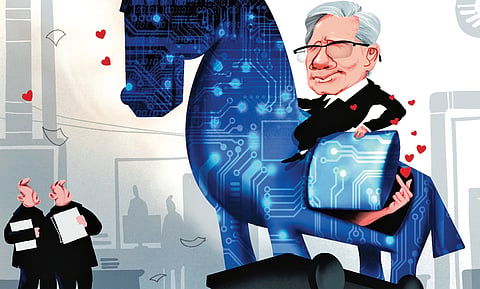

In the Insta world, the ‘Kodak moment’ has morphed long ago into the ‘Coldplay moment’. This week, the romantic dalliance of Nvidia CEO Jensen Huang with Alice Huang, allegedly a Chinese spy, lit screens across the world. The meme-world is ablaze. If the old maxim said that two wrongs don’t make a right, it’s now saying two Huangs don’t make it right. As the headlines play out, the capital markets are trying to price the risks.
Markets pride themselves in their ability to price anything and everything. They price wars, monsoons, elections, the derby and even the mood of central bankers. Nvidia can insure against fire, hedge its currencies, buy cover for its directors and even takes out a key-man policy in case the boss meets a bus. What companies and markets have struggled with is how to price character, how to map the unknown risks of leadership. The fatal attraction here is not the one between the Huangs, but between the market and a stock.
Beyond the salacious imagery, the worry for the investor world at large is if the AI rally will hang with Huang. Nvidia is around 6 percent of the S&P500 index, 10 percent of the Nasdaq100 and is on pension fund assets across the world. The best they have is phraseology: key-man risk. Ergo, they assume it and pay for the assumption when the unknowns become known.
Since Jensen Huang confessed to his extramarital affair on November 8, his company has lost over $500 billion in market cap. Huang, who owns 3.6 percent of the stock, lost more than $15 billion. Of every dollar that vanished, a little under four cents was his.
The rest belonged to index funds, pension plans, insurers and the households behind them—none of whom were consulted on his weekends. The affair was private. The invoice is public.
Economists, being economists, have looked at the phenomenon. In 2018, Brandon Cline, Ralph Walkling and Adam Yore published a paper in the Journal of Financial Economics with the unimprovable subtitle ‘Sex, Lies and Firm Value’. They tracked 219 indiscretions by executives, the sexual, the dishonest, the intoxicated and the violent. On disclosure, the average company lost 1.6 percent of its value, or $110 million. When the sinner was the CEO, the loss was 4.1 percent, or $226 million. Nvidia’s Monday was a textbook illustration with more zeros.
As the markets lathered, as Nikkei and Nasdaq yo-yoed, the board lawyered up preparing for a multitude of probes by an array of three-letter agencies, and enquiries by US House and Senate committees. Setting the stage for the company’s defence, the board ousted Huang on November 12 and sppointed Chief Financial Officer Colette Kress as interim CEO.
Great power, great temptations
Nvidia’s is not the first CEO tripping on frailties. With great power comes great temptations. Literature has covered the ground the prospectus is struggling with. “I can resist everything except temptation,” says Lord Darlington in Oscar Wilde’s Lady Windermere’s Fan.
Harry Stonecipher, brought back to clean up Boeing’s ethics, was asked to resign in 2005 over an affair with a female executive. Mark Hurd left Hewlett-Packard in 2010 after an inquiry into his relationship with a contractor. Brian Krzanich quit Intel in 2018 over a past relationship with an employee. Steve Easterbrook was sacked by McDonald’s in 2019, and Andy Byron of Astronomer gave the Coldplay moment its name in 2025.
As it always turns out, the plot is older. Ever since Washington curbed sales of advanced chips under the Biden administration in 2022, the many eyes and arms of US intelligence were tracing transactions and relations. Last Spring, a highly confidential memo went around to the top honchos of the Trump administration that a Chinese woman close to the Nvidia chief was a spy for the China’s ministry of State security.
The troubles of Nvidia are likely to occupy prime time for weeks. The chairs of three Congress committees—the House China Committee, the House Foreign Affairs Committee and the House Intelligence Committee—have already summoned Huang to a closed-door meeting on November 18.
Should the Nvidia board have known better? Boards do have filters. The trouble is the mesh. Related-party rules—the Securities and Exchange Commission’s Item 404 in the US and Section 188 of the Companies Act in India—define a related party by blood, marriage, household and shareholding. A lover is not a relative. The law requires arm’s length relationships—rarely has a term been burdened with so much responsibility—with customers/clients. The SEC rule bites when accounts are restated, but not when vows are violated.
The question every board ducks is the ‘what if’. Yes, there is a peculiar problem with founder companies. Tesla, for instance, has informed shareholders that “we are highly dependent on the services of Elon Musk“ as if confession were a cure. Nvidia, which had crossed a valuation of $5 trillion as the world’s most valuable company for a while, had a peculiar operating structure. Huang had over 60 heads reporting directly to him in a style he called “extreme co-design”, which he said fosters innovation and accountability.
The chip-maker has no clear succession plan for such a large enterprise representing a landscape of systemic risks—from debt to equity, from supply to services. When the National Association of Corporate Directors asked American boards in 2024 about succession plans, 30 percent had no CEO successor identified “if the chief left tomorrow”.
It is not that it cannot be done. Tim Cook ran Apple while Steve Jobs was ill before he inherited it. The saga has many parallels in India. The exits at Flipkart and iGATE are merely cases that surfaced. The troubles are often swept under the carpet. The need to map the law to check the myriad maze of relatives and relationships awaits the next scandal.
The Kodak moment went into the family album. The Coldplay moment into the mutual fund statement. Wilde’s lord could afford his quip; he was spending his own money. Stakeholders deserve a board that has planned for the day the camera swings round.
(Views are personal)
Read all columns by Shankkar Aiyar
(shankkar.aiyar@gmail.com)
Author of The Gated Republic,Aadhaar: A Biometric History of India’s 12 Digit Revolution, and Accidental India
