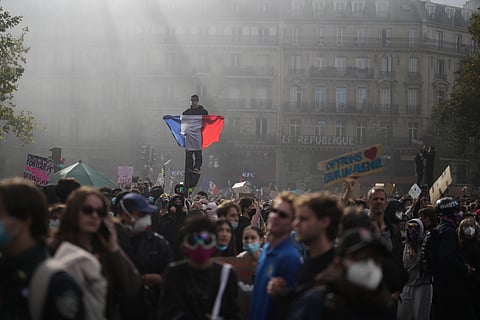

In 1976, a television anchor told America to go to the window and shout that they were mad as hell. Americans did. In October 2026 the window is a touchscreen connecting rage and the outraged. in 1976 the network booked the ratings. In 2026 the platform algorithms net the eyeballs and the revenue.
France has raged for more than four weeks as students protest teacher shortages and crumbling classrooms. On Friday the government mobilised 70,000 troops to keep order. In Albania, students set fire to the education ministry. In Rome, students blockaded schools and observed a ‘No Meloni Day’. In Madrid, protests about housing, rent and wages have turned Puerta del Sol into a tented campsite. In Delhi, the young turned an insult into a movement. The Cockroach Janta Party became the platform for agitations—about paper leaks, schools and denial of voter registration. In Germany, students protested in 100 cities raising the issue of broken schools, conscription, austerity and cost of living. This is to be followed by rallies by a GenZ steht auf (stand up) on October 31. Cost of education and poor public sector pay united students and unions in Belgium. Portugal’s protesters want housing and better wages. Every protest is about access: to a classroom, a job, a lease, a vote, a voice.
Tolstoy opened Anna Karenina with the observation that happy families resemble one another, while every unhappy family is unhappy in its own way. So it is with the young—their complaints differ by capital, but rhyme. The world is simmering with unattended issues. Youth unemployment is in double-digits. Immigration is weaponised.
Gen AI is retrenching early- and mid-level jobs. Interest rates are higher and promise to stay there. Sovereign debt is at an all-time high. It could be argued that Trumponomics has aggravated the conditions, yet the US has seen no youth-led wave. Not as yet.
Few of these grievances are new. Some are prime examples of wilful blindness. Troubling questions on housing, wages or condition of schools and healthcare do not sprout overnight. The harsh truth is that politicians are skilled at weaponising consequences, but have no time to address the causative factors. The student, the renter and the first-time voter are making one argument in different languages: the future has been upended, and they are left without a say. The magnitude of discontent is huge.
Nearly half of humanity is under 30. Their idiom is the online feed. Six billion people are online, and 82 percent of 15-to-24 year olds use the internet. The grammar is irony. The CJP’s Instagram account has over 25 million followers. Albanians march behind cardboard flamingos. The Jolly Roger flutters at youth rallies across Europe, Nepal and Indonesia. In Nepal, tens of thousands voted on Discord for an interim Prime Minister. Italian students urge protesters to “fare come in Francia” (do as France does), and Madrid campers hold tutorials for youths from elsewhere.
It is also a generation that lives by the lens. The march, the arrest, the baton and the burning ministry are clips before they are events, instruments of mobilisation. This is the experiential generation. It is used to answers at the tip of a finger and end of a swipe. To this cohort, the adult is insolent not only in tone but in tempo, and slowness is itself an insult. The impatience is not frivolous. A leaked paper or a deleted name is a failure of fairness, the one thing the young were promised. The adults hear tempo as disrespect and tell the young to be quiet. A placard in Nantes, copied from a May 1968 Atelier Populaire poster, with Macron’s silhouette, said, “Be young and shut up.”
The young are also told they are not the authors of their script. Typically, many regimes have triggered the ‘foreign conspiracy’ clause. Albania’s Edi Rama said, “Foreign hands that do not wish for Albania to be at peace.” Serbia’s Aleksandar Vučić called the students’ movement a foreign-funded colour revolution. In India, the BJP and the RSS have blamed, named and then unnamed foreign interests behind the protests. Macron says foreign leaders, Trump among them, are using the riots for their own campaigns. Fox News Digital alleges a network of 50 groups is behind the students.
Mao said a single spark can start a prairie fire. This generation has lit many small ones. Celeste Ng put the thought in a title, Little Fires Everywhere. In 2011, a Tunisian street vendor’s self-immolation lit the Arab world. Sri Lanka, Bangladesh and Nepal witnessed violent protests and deaths that forced presidents and prime ministers to flee from their people. Serbia is the live test. Students have fielded a 250-candidate list called Students Win in Sunday’s snap election. Governments fall easily, forced by fear and fervour. What follows is the test. Will the live labs in Sri Lanka, Bangladesh and Nepal deliver? Anton Jäger’s Hyperpolitics calls this extreme politicisation without political consequences. His argument, in short: mobilisation is easy, organisation is hard. Anger and motivation erode and circumstance evades promised outcomes.
The larger question, though, is not about success and failures. Democracies must reflect on the why, rather than the who and how. Far-left or far-right? The labels rarely fit. Anti-government is not a political identity; it is a mood with a megaphone. In any democracy, the ballot counts but it arrives once in four or five years, between which there is no room for questions. Democracy works only if someone in power is bound to answer. A town hall without responses and consequences is hyperpolitics with chairs.
The young are not asking for a revolution. They are asking for tenancy in their own future. Governments call it disorder. Disorder is what a message looks like when no one receives it.
Read all columns by Shankkar Aiyar
Shankkar Aiyar
Author of The Gated Republic, Aadhaar: A Biometric History of India’s 12 Digit Revolution, and Accidental India
(shankkar.aiyar@gmail.com)
