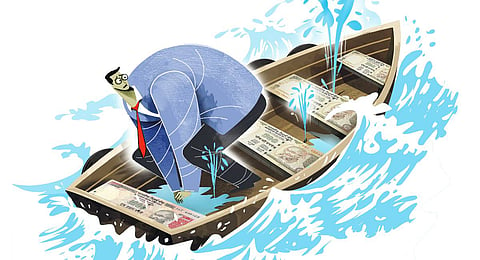

When in doubt, turn left. The old trick to exit from a maze is now the go-to hack of the political right. From Washington to London to Lucknow, parties that built their identity on conservatism, free markets and small government are the ones expanding the State’s role and writing out cheques. They call the payouts dividends, income support, enterprise capital—anything but welfare.
On Wednesday, US President Donald J Trump promised to “issue a dividend to every adult citizen in the US for $5,000—if Republicans hold both chambers of Congress in November”. No details on the funding mechanism. No legislative draft—just a figure and a condition. Roughly 14,000 km away, in Lucknow, UP Chief Minister Yogi Adityanath announced the rollout of a scheme entitling one crore women Rs 1 lakh credit without interest under the Mahila Udyami Credit Yojana.
Trump and Yogi are not an odd couple. Earlier this week, Reform UK chief Nigel Farage promised Britons tax-free personal allowance to £15,000 and a £250 cut in energy bills. He also proposed to launch a Britannia Card that billionaires can buy at £250,000 for a 10-year residency permit. It would guarantee no tax on foreign income and the card fees will be used to pay low-income British workers £600 to £1,000 a year.
Same week, different hemispheres, different currencies, different promises, similar vocabulary—dividend in one capital, capital in the other and tax cut in the third. The same instinct: the State as benefactor, arriving with a cheque, a credit card and a rebate coupon as the electorate gears up to decide who will take charge of the till.
In Europe, the ultra-right is rail-roading traditional parties with leftist policies. French far-right leader Marine Le Pen has promised to reverse Emmanuel Macron’s pension reforms. Poland’s budget deficit reached 7.3 percent of GDP in 2025, more than double the EU average of 3.1 percent. Yet the country’s Law and Justice (PiS) party, which ruled Poland till 2023, lowered the retirement age, expanded universal child benefit and added pension benefits loading costs on the exchequer.
In Germany, the rising popularity of AfD owes a major share of its success to welfare chauvinism. It has argued against immigration and pointed out that a large portion of Germany’s Bürgergeld (citizen allowance) goes to foreign nationals burdening the working class. Effectively, it doesn’t fight welfare but wants to control who gets it.
In Italy, Georgia Meloni’s government is running welfare nationalism inside fiscal discipline. Deploying identity clause for sops, it has offered a €1,000 tax-free bonus for every child born or adopted, and allowance for working mothers.
The idea of democratisation of cost and personalisation of power is not new. Otto Von Bismarck, who introduced Europe’s first social insurance, accident insurance and old age pensions, apparently said those who are dependent on government pension are far easier to handle than those who have no such prospect. It is believed Bismarck even invented government-run retirement. Mussolini broadened dependence by ramping up public employment over a decade, apparently to put intellectuals on the public payroll so that they would have incentives to praise him endlessly.
Political promises are akin to the retail trade’s buy-now-pay-later schemes. The costs manifest first in cost of capital and then in the balance sheets of governments. Trump, for instance, may have skipped past the arithmetic of his promise but the consequence manifests soon enough. The $5,000 ‘Trump Dividend’, as DJT calls it, will cost the US government over $1.2 trillion—and the gift transfer of $5,000 at current interest rates will eventually cost Americans $8,000.
By Friday, the bond markets rang the alarm as yields went up—the 10-year at 4.97 percent and the 30-year at 5.35 percent, the consumer price index is up and the market is betting on an interest rate hike by the US Federal Reserve next week.
The BJP-led NDA has repeatedly campaigned against the promise of “freebies” by opposition parties. In 2014, the party promised fiscal discipline and efficient allocation of resources. In 2026, the government of India runs the world’s largest welfare programmes—free food covering over 81 crore people, rural employment dole, health insurance and farmer income support. BJP-ruled states have patented the concept of cash transfers as Ladli Behna or Ladki Bahin schemes for women voters.
Worldwide, government debt has climbed over $111 trillion. More than 3.4 billion people live in countries spending more on interest than on health or education. The price of political sops is visible on the books of India’s central and state governments, too. The Union government’s gross borrowings for 2026-27 are at Rs 17.20 lakh crore, or Rs 4,712 crore a day. The interest cost: Rs 14.03 lakh crore or Rs 3,846 crore a day.
RBI data shows outstanding liabilities of all states amounts to Rs 104.28 lakh crore. The liabilities of Adityanath-ruled Uttar Pradesh are Rs 8.83 lakh crore. The Devendra Fadnavis-led BJP government of Maharashtra has outstanding liabilities of over Rs 9.37 lakh crore. Tamil Nadu, now under superstar Joseph Vijay, tops the rank at Rs 10.42 lakh crore. The context is critical. The upending of familiar economic models—thanks to ageing demography, climate change and accelerated retrenchment of human interface by technology—demands a new social contract between the State and the citizen.
Frédéric Bastiat—French economist and legislator, and someone who knew how the trick looks from inside—framed it succinctly in 1848: “The State is the great fictitious entity by which everybody endeavours to live at the expense of everyone else.” What has changed is not the fiction. It is who has learned to tell it best. When in doubt, the political right no longer turns right. It turns left, hands out cheques and leaves the mess to whoever inherits the maze.
