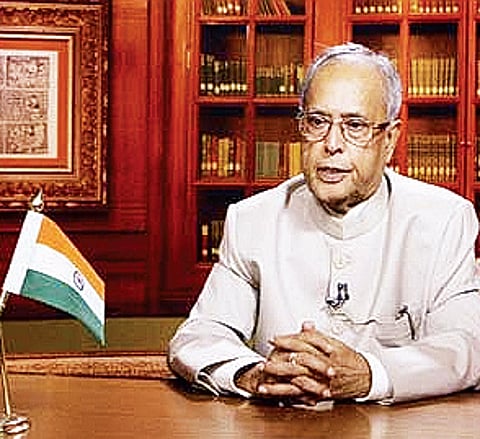

Duty of Tolerance: President Pranab Mukherjee sent a message to the Supreme Court Bar Association on the occasion of flag hoisting on Independence Day. The message highlighted that lawyers should make people aware about their rights as also duties. In substance, it emphasised the basic truth that exercise of every right has a corresponding duty to be fulfilled. The co-relation between rights and duties is not a new fangled idea. Our ancient rishis and sacred texts emphasise the importance of duties. Bhagawad Gita teaches us that “your duty is your right”. Gandhiji summed up the matter admirably: “I learned from my illiterate but wise mother that all rights to be deserved and preserved come from duty well done.”
Lawyers have largely invoked Part III of our Constitution which guarantees certain fundamental rights because they are judicially enforceable. Part IV-A of the Constitution, which prescribes with felicity of language certain fundamental duties of every citizen, has been generally overlooked, possibly because it is problematic whether these duties can be judicially enforced. One of the fundamental duties is “to promote harmony and the spirit of common brotherhood amongst all the people of India transcending religious, linguistic and regional or sectional diversities; to renounce practices derogatory to the dignity of women” [Article 51-A(e)]. To my mind, the duty to practice tolerance is implicit in the said duty and in present context that is the need of the hour. Intolerance rears its ugly head in the field of literature, historical writings, biographies, ‘hurtful’ plays and movies, decency in the mode of attire etc. Intolerance cannot tolerate non-conformism; it cannot brook dissent. And when the dissenter is exposed to social and extra legal sanctions, democracy is under siege.
However, the duty to practice tolerance cannot be legislated nor can it be effectively enforced judicially. Therefore, we must develop the capacity for tolerance by fostering an environment of tolerance, a culture of tolerance. In its celebrated judgment in S Rangarajan v. P Jagjivan Ram, Justice Jagannatha Shetty speaking for the court ruled that “freedom of expression, which is legitimate and constitutionally protected, cannot be held to ransom by an intolerant group of people”. The court emphasised that “we must practice tolerance to the views of others. Intolerance is as much dangerous to democracy as to the person himself.” Hopefully, lawyers will pay heed to the President’s salutary message about duties of citizens.
Plagiarism Itch: It is a pity that plagiarism itch overcame commentator Fareed Zakaria who admits it was a terrible mistake. Plagiarism has been variously described. In books or plays, such imitative acts are called plagiarism; in commercial art or design, it is called ‘piracy’; in general it is given the colloquial term ‘chiseling’, or more appropriately cheating. In essence, plagiarism consists of using someone else’s ideas or writings as one’s own without acknowledgement of the source. It is more an ethical than a legal issue.
Apparently, plagiarism has afflicted quite a few eminent personalities. It is said that Martin Luther King’s seminal, “I have a Dream”, speech resembles Archibald Carey Jr’s address to the 1952 Republican National Convention. In the first half of the 19th century, celebrated writer Stendhal is said to have plagiarised excerpts from works of several famous authors. Nearer home, former editor of Hindustan Times, VN Narayanan, is alleged to have lifted 1,020 words of his 1,263-word column titled, ‘For ever in transit’, from Sunday Times’ columnist Bryan Appleworth’s article titled, ‘No time like the present’. Incidentally, judges both of the high courts and the Supreme Court are not immune to this weakness. Some resplendent judicial passages are borrowed from earlier foreign or Indian judgments or works of legal authors. There is, of course, no intention of cheating. The problem is that their stenos who took the dictation just forgot to put “ ” before the flowery passages. One is reminded of T S Eliot’s quip, “Good writers borrow, great writers steal.”
solisorabjee@gmail.com
Sorabjee is a former Attorney General of India
- Sunday Standard