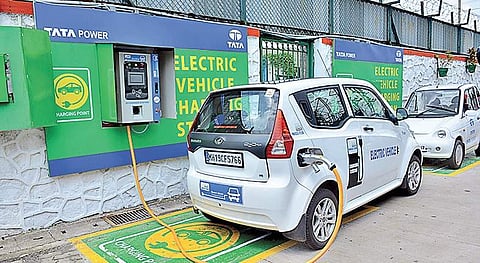

The Centre’s push for clean mobility by promoting electric vehicles (EVs) across private and commercial transport sectors is without doubt the need of the hour. But blanket imposition without laying a clear roadmap will prove to be counterproductive. The Centre must take structural changes, infrastructure creation, facilitation of manufacturing, affordability of vehicles, feasibility of operation, etc., into consideration.
Reports of the Centre’s plans to ban the sale of all fossil fuel-using three-wheelers by April 2023 and all two-wheelers below 150cc by 2025 have expectedly caused ripples in the automotive industry. The Society of Indian Automobile Manufacturers has already voiced its concerns, stating the country is not ready for such changes and that they could even destroy the industry.
The SIAM says the automotive industry, which accounts for almost half of manufacturing GDP, will undergo a tectonic shift in order to integrate EV production in a wholesome manner. With no foundation for EV manufacturing localisation coupled with the absence of infrastructure for fuelling consumer adoption, going ahead will simply turn the market upside down.
The ground realities also corroborate the fears. In 2018-19, around 2.10 crore two-wheelers were sold in the country of which nearly 90 per cent belonged to the sub-150cc bracket. Electric two-wheeler sales were a little over 1.20 lakh in comparison. Despite being introduced long ago, electric three-wheelers have not been able to gain a foothold in transport.
The major impediments are high costs, lack of charging infrastructure and, more importantly, quality of vehicles, particularly the batteries. While the shift to EV is imperative, the government should prioritise infrastructure creation, incentivisation of EV use as well as support manufacturing sector before the roll-out. The extension of FAME scheme is a step in the right direction but much more needs to be done and four years appear to be too short a time-frame.
