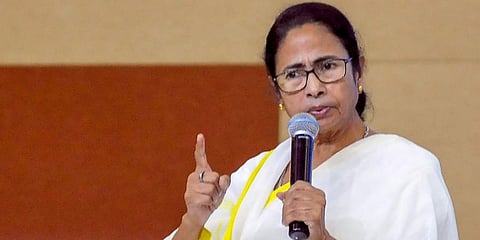

If Trinamool Congress head and West Bengal Chief Minister Mamata Banerjee indeed wanted to drive a wedge between the RSS and the BJP, as she praised the former recently, it was certainly worth a try. Her tactic, if that was one, was completely lost on the opposition fellow travellers who tore into her commitment to secularism. But that was a myopic reaction. The Sangh’s initial need for a political arm was to protect itself from predators. During and shortly after the Independence movement, the RSS fobbed off pressures for merger with the Congress. Then came the dastardly assassination of Mahatma Gandhi in 1948 for which the Sangh was framed and banned. From its heights of popularity for its services during Partition, the organisation became not just vulnerable but also untouchable. That was when the idea of floating a political wing to lobby its cause germinated. The Bharatiya Jan Sangh was born in 1951.
If the RSS needs the party as an armour, the latter requires the Sangh’s grassroots work during elections. Power would slip out if for some reason their symbiotic bond is weakened. When the Janata Party government fell on the dual membership issue in mid-1979, Atal Bihari Vajpayee sought to build distance from the Sangh by floating the BJP instead of reviving the Jan Sangh, expounding a new ideology called Gandhian socialism. With the angry Sangh staying away from the Lok Sabha polls in 1984, the party could win just two seats as compared to a sizable tally of Jan Sangh representatives in the merged Janata Party in the 1977 elections. Even now, the Sangh alone has the ability to deliver votes at the booth level despite whatever the party’s self-styled Chanakyas might imagine. Unlike when Vajpayee was at the helm, the BJP is now unapologetically committed to the Sangh’s core agenda of cultural nationalism, including Article 370 and educational reforms, making the two tightly intertwined.
Yet, Mamata is right that many in the RSS do not like the riff-raff in the BJP. The complete centralisation of decision-making, excessive play of money power and attempts to capture power by any means are abhorred by idealists. Politicians aligned with the Sangh ideology are not just in the BJP, they are well dispersed in various other parties as well. So, attacking the BJP while giving the RSS a comparatively free pass to try and loosen their mutual bond does look like a decent political strategy.