
India can yet find a silver lining around the Gulf war’s dark clouds. As the conflict strains cooking gas supplies across the country and triggers panic, it’s an opportune moment to redouble efforts to develop more sustainable alternative energy sources, especially biogas, and reduce dependence on liquefied petroleum gas. The need is all the more urgent as the crisis is forcing many Indians to go back to cooking on wood fire, threatening forests and worsening pollution.
Consider the numbers. India’s consumes 3.1 crore tonnes of LPG a year, three-fifths of which is supplied by imports. A fifth comes through the war’s epicentre, the Strait of Hormuz, whose choking has forced India to identify sources other than Qatar, the UAE, Saudi Arabia and Kuwait. Indeed, the more expensive imports from the US, Argentina and Australia have been increased.
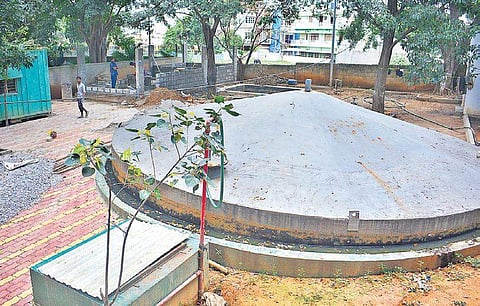
In sharp contrast, biogas systems offer an affordable and sustainable low-tech alternative. The one installed in 1987 at the Dudhsagar plantation in Goa has replaced LPG ever since, using only kitchen waste and cow dung to produce the gas that runs its kitchen. Today, about 43.1 lakh households across India have biogas systems. The current production is of 207 crore cubic metres a year; but experts claim there is enough potential to increase it to 4,800 crore cubic metres.
Biogas is produced from biomass sources—agricultural residues, cattle dung, sugarcane press mud, municipal solid waste and sewage treatment waste—through anaerobic decomposition, a natural process wherein microorganisms break down organic materials in sealed oxygen-free containers called digesters. Compressed biogas (CBG) has properties similar to compressed natural gas and can be used as a green alternative to replace CNG in the automotive, industrial and commercial sectors. With 6.20 crore tonnes of biomass generated annually, biogas production can be endlessly sustained in India.
In 2018, the Union government had rolled out the Sustainable Alternative Towards Affordable Transportation scheme to produce 1.5 crore tonnes of CBG annually—two-fifths of India’s total CNG consumption—by setting up 5,000 plants. Now it needs to work with the states to help people set up many more household biogas systems. It can be a part of the “pandemic-like preparations” that the Prime Minister warned might be required to tide over the crisis. Significantly increasing biogas production should feature near the top of such measures.
