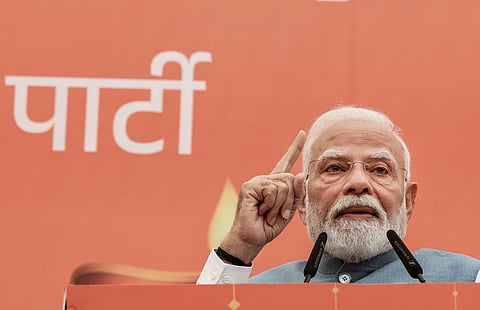

Explaining India’s growth story can be a complex task. But then, Prime Minister Narendra Modi is an expert at unravelling complexities. His message at the Diwali media meet in Delhi was concise: go beyond the daily news cycle and become chroniclers of a nation in the midst of transformation. Modi is a master of nuanced communication: with characteristic humour, he thanked journalists for attending a gathering of “non-breaking news”.
The lighter moment set the tone for a larger message about the urgency of India’s development ambitions. His analogy between newsroom deadlines and national development targets was an innovative twist on how deadlines speed up the pace of work, sharpens priorities and creates a sense of purpose. India’s ambition of becoming a developed nation by 2047, he clarified, needs similar commitment.
Modi’s appeal to showcase the India Story was particularly significant. Citing the country’s young population, affordable data services and achievements such as Chandrayaan-3, the Chenab railway bridge and UPI, he highlighted India’s growing technological and engineering capabilities.
Journalists must seek out grassroots stories of innovation, enterprise and social transformation was the fundamental message, as he drew a parallel with Mann Ki Baat, which brings lesser-known achievers and local initiatives into the national conversation. Most important was his appeal to publicise the danger of substance abuse among youth, and raising awareness about deepfakes.
It was a reminder that journalism’s influence extends beyond reporting events to shaping public awareness and encouraging collective action.
Modi was both Prime Minister and chief editor on the stage; his view was that reporting on infrastructure expansion, technological innovation and entrepreneurial energy must go hand in hand with explaining their economic and social impact.
This explains how the country’s progress is not a single narrative but a multitude of stories unfolding across regions, industries and communities. Bringing them together can help citizens understand both the scale of change and the possibilities ahead through sustained effort from every institution.
The media has a distinctive contribution to make in this endeavour: showcase achievements while illuminating shortfalls, connect local successes with national aspirations and keep public attention focused on the road ahead. Telling the India Story is not simply about celebrating how far the country has travelled; it is also about helping Indians understand how much farther India can go.
