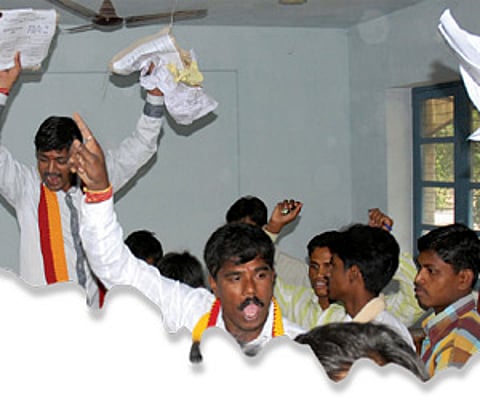

I was intrigued to read of a Karnataka chauvinist party which, in the manner of Bombay’s Shiv Sena or its breakaway faction, the MNS, attacked a group of outsiders who took the railway exam in Bangalore. It’s not that the South is any stranger to regional chauvinism — after all, river water disputes usually turn into chauvinistic exercises — but somehow one had the sense that Bangalore had become comfortable with its transition from sleepy colonial town to international metropolis. But then, I guess few cities ever make the transition almost entirely painlessly.
There are swathes of London where you can walk for hours and not see a single native — English speaker. And in Paris, the Arab quarters seem part of another world. In both cities, the arrival of so-called outsiders has been the trigger for violence, chauvinism and rioting. So it is too much to expect either Bombay or Bangalore to be entirely free from this phenomenon. The difference, of course, is one of nationality.
When the citizens of Paris protest, they are not complaining about people from Provence making their homes in the national capital. In London, nobody minds that people from Devon may have moved to the city. It is foreigners who evoke violent responses.
In India, on the other hand, few so-called ‘foreigners’ have become the issue. There may be some resentment of illegal migrants from Bangladesh but that’s about it. Nepalis rarely evoke strong emotions even though there are millions of them in India. Nor do Sri Lankan Tamils. And you could well argue that one reason why the Bangladeshis have it hard in India is not because they are foreigners but because they are Muslims. (Bangladeshi Hindus rarely provoke much of an outcry.)
When we protest in India, it is nearly
always about people from other parts of the country, not about foreigners. And intriguingly, the complaints follow no set pattern.Let’s take Calcutta, home to lakhs of Biharis. Rarely, if ever, do the Biharis become an issue. Bengalis are quite willing to live with the very visible presence of people from Bihar without feeling a) that their culture is in danger or b) that their jobs are in peril. (Even though, in Bengal, Biharis have taken many of the jobs that Bengalis would have got if they were prepared to work hard.)
Or take the example of Delhi. For all practical purposes, Delhi is now a Punjabi city. The middle class is solidly Punjabi and so is the city’s popular culture. But this was not always so. During Partition, when Hindus were driven out of their homes on the other side of the border, they streamed into Delhi.
The exchange of populations that took place in 1947 has often been described as the greatest mass migration in the shortest possible space of time in the history of the world. When the refugees arrived in Delhi, they had nothing. They lived in camps, and struggled to make a living. The people of Delhi could have turned against them and complained that the character of their city was being transformed forever. In fact, they did no such thing. They welcomed the refugees with open arms and helped them start new lives in a new India. As the Punjabis flourished and prospered, so did Delhi.
Over the last two decades, there has been another transformation in Delhi. People from UP and Bihar have flooded into the city looking for work. Once again, the city has been largely welcoming even though this flood has made a dramatic difference to Delhi. One
instance, this was always a Jan Sangh/BJP city because the BJP catered to the needs of Delhi’s Punjabis. But now, the new voters prefer somebody like Sheila Dixit, who is from UP, and not Delhi, over such Delhi Punjabis as Madanlal Khurana and VK Malhotra. That’s why the Congress has won three elections in a row here.
I won’t make any judgements about Bangalore because the recent violence could be an isolated incident. But why does Bombay react so differently from Delh or Kolkata? Why is there so much resentment of other Indians?
Part of the reason, I suspect, is because Maharashtrians had very little to do with the development of Bombay. The city was built by Gujaratis, Parsis and Muslims and not by Maharashtrians whose centres were such cities as Poona. Nor was Bombay seen as a Maharashtrian city in 1947. In fact, there was no state of Maharashtra at all. Bombay became a state and the old Bombay state included most of Gujarat. The first Chief Minister Morarji Desai was a Gujarati.
In the late 1950s, Maharashtrians recognised that as the principle of linguistic states was being accepted elsewhere, they had a claim to a state of their own. A long agitation led to the creation of Maharashtra in May 1960. But even then, there was no unanimity over granting Bombay to this state. But
Maharashtra fought for the city and eventually it became the capital of Maharashtra.
Many, if not most, Maharashtrian families who live in the city of Bombay have not been there for more than three generations. Their ancestors moved to the city in search of better prospects. So they have no real claim on Bombay’s history. But because they had political power and because more and more Maharashtrians kept streaming into the city. Marathi chauvinism began to develop around 1966 with the formation of the Shiv Sena.
The Shiv Sena demanded jobs for Maharashtrians that they would not necessarily have got on merit. Its first targets were South Indians who had the jobs the Maharashtrians wanted. Next, it started on the Gujaratis who were in a position to hand out those jobs. Now, unfortunately, decades of Shiv Sena brainwashing have convinced young Maharashtrians that Bombay is their city, that they built it and that outsiders are coming to share in the wealth they created.
This is utter nonsense. Even today, the
Maharashtrians are not the biggest wealth-creators in Bombay. They just run the city because of chief ministers who draw their support from other parts of Maharashtra. Why has Bombay reacted so differently? Why has it been so small-minded and petty when other cities have been large-hearted? I don’t know. Do you?