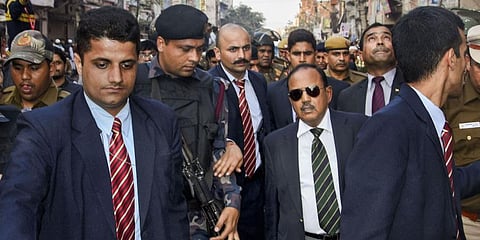

When National Security Adviser Ajit Doval was handed over the responsibility of reviewing the law and order situation and restoring normalcy in the riot-hit areas of Northeast Delhi, it was widely seen as a snub to Union Home Minister Amit Shah since the Delhi police directly report to him.
It was said that Doval was picked for this sensitive job because Prime Minister Narendra Modi was unhappy that the communal carnage was not put down firmly by the Delhi police and that the three-day violence had cast a shadow on US President Donald Trump’s visit to India. It was also pointed out that this move was a clear signal that the Prime Minister had personally stepped in to ensure that the situation was brought under control at the earliest.

This has predictably led to speculation about growing differences between Modi and his confidant and Cabinet colleague Amit Shah.
The Home Minister has been in the eye of a storm for not taking prompt action in putting an end to the Hindu-Muslim riots.
He was under attack for not visiting the violence-affected areas and instilling confidence among the people. Given the long-standing friendship between Modi and Shah, it is difficult to accept that there are serious differences between the two.
In fact, it is now accepted that they work in tandem. In this case, there were compelling reasons on their part to outsource the task of restoring peace in Northeast Delhi to Doval.
The move was calculated to help both Modi and Shah. If the NSA was perceived to be Modi’s personal choice, it would automatically insulate the Prime Minister from any adverse fall-out of the Delhi violence and preserve his image as a global statesman.
At the same time, Doval’s presence removed Shah from the firing line and reduced the ugly communal carnage to a mere law and order problem. It also helped put an end to the incessant criticism that Shah was incommunicado during the riots.
Doval’s deployment also came in handy for Shah who had to necessarily protect his reputation as a Hindu hardliner. Shah has always worn his ideology on his sleeve and is unapologetic about indulging in more than a spot of communal polarisation, especially when an election has to be won. Incendiary speeches and statements have become his trademark.
Last year, he had described immigrants as “termites” and promised that they would be identified and thrown into the Bay of Bengal. There was evidence of the same during the recent Delhi Assembly poll when the Bharatiya Janata Party’s campaign, planned and supervised by Shah, deliberately kept the focus on the Shaheen Bagh protests against the amended citizenship law in a bid to demonise Muslims and consolidate the Hindu vote.
It would, therefore, just not do for Shah to be seen reassuring riot victims, particularly those belonging to the minority community, that they would come to no harm. It would be an anathema to the BJP’s hardcore support base.
Shah was well aware that his carefully-crafted image would have taken a beating if he had visited the affected areas. It was for the same reason that Modi, as Gujarat Chief Minister, had refused to wear a skull cap when presented one at a public event.
It can be safely assumed that Shah is unlikely to be disconsolate over the manner in which the Delhi riots panned out, helped in large measure by a complicit police force. Ever since the protesters hit the streets against the amended citizenship law, the National Register of Citizens and the National Population Register, the BJP in general, and Shah, in particular, sought to project the agitation as the handiwork of an “anti-national” Muslim community.
But the widespread support it received, especially from the youth, made it difficult to give the protests a communal tinge. It was equally hard to paint the agitators as anti-national when they proudly displayed the Indian Tricolor, held up copies of the Constitution and sang the National Anthem with gusto. The fact that the sit-ins were peaceful also failed to provide the necessary boost to Shah’s campaign. The Delhi riots have changed all that.
The ugly carnage witnessed over three days has left deep scars and created a huge Hindu-Muslim divide. The violence may have been confined to a small geographical area of the Capital, but the message from here has travelled far and wide. The BJP’s majoritarian agenda has taken deeper and firmer root.
Shah will not be unhappy at the turn of events. It will only aid his future electoral campaigns as he looks ahead at the next set of Assembly polls in Bihar and West Bengal. It’s back to basics for Shah and, contrary to public perception, Modi is on the same page.
Anita Katyal
The writer is a senior journalist. This column will appear every fortnight