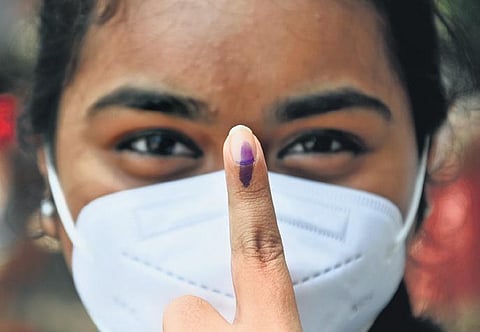

In auditing, there is a concept called Perpetual Inventory Management. It essentially means taking stock of stores and spares in a phased manner so that the entire inventory is covered at least once a year. Though we did not have any accountants at the helm of the country or among the framers of the Constitution, somewhere along the line, we seem to have lapsed into a system of perennial elections. Such a practice is not heard of in other major democracies in the world.
Long ago, when this writer used to work for a leading vanaspati and edible oils manufacturer, the marketing team maintained a calendar of major festivals such as Diwali, Dussehra, Pongal, etc. It was at these times the sale of sweets and, consequently, vegetable oils peaked.
Later, when he worked for a cement company, elections assumed greater importance. There is a surge in demand for cement in the run-up to every election—be it panchayats, local bodies, municipalities, states and Centre—as the administration goes on an overdrive to complete pending development work. Equally, there is a lull after the elections till the new administration takes over and budgets are sanctioned.
It is not cement alone; a large chunk of the country’s Gross Domestic Product (GDP) is generated from the economic activity surrounding elections across sectors. From services like event management, logistics, media, advertising and marketing—elections boost a sundry other industry ranging from white goods (distributed as freebies) to automobiles and liquor. Spare a thought for television channels and, now YouTubers, who thrive on year-round elections for producing content. When newspaper circulation is dwindling across the world—political advertisements work like a life support system for print media. Add to these the headcount of the Election Commission, supplementary police and paramilitary forces that need to be kept on standby for election duty, and the contribution of elections in job creation would be mind-boggling. But we should not digress from the main political question.
‘One nation, one election’ is not a new concept. Though not explicitly stated in the statute books, it seems to have been the assumption of the framers of our Constitution. Midterm elections, either in the states or the Centre, were envisaged to be an exception rather than the rule. Thus, till about 1967, simultaneous elections of Lok Sabha and State Assemblies were the norm. It was only after that did the trend of dismissal of governments in midterm and imposition of President’s rule begin upsetting the election calendar of the country.
Next, in the Seventies, we had unstable governments lasting less than their full term at the Centre, further muddying the waters. It can be argued that holding frequent elections is the price of democracy that the nation should be willing to bear in its interest. Fractured mandates also reflect the will of the people and a vibrant polity. But beyond a point, does it run the risk of making democracy dysfunctional?
Much has been discussed on how keeping the country continuously in an election mode impacts governance. Elections are a major distraction for politicians, especially those in office. Instead of attending to the tasks of running the government or playing the role of an effective opposition, they must frequently take time off for campaigning. But the biggest casualties are economic and administrative reforms. Apprehensive of collateral damage in state elections, the Central government is often forced to put off hard decisions. This has also started a culture of freebies to secure quick wins. As a result, sometimes, issues of national importance get scuttled in local elections. Take, for instance, the case of the Pension Scheme. Introduced by the UPA government, it is now being reversed in many states—ironically due to pressure from the Congress party, the original author of the reform. Political parties often find it inconvenient to fight elections on real issues of governance, economy, jobs, and development which are often a case of the pot calling the kettle black. Therefore, to divert attention or counter anti-incumbency, they resort to “vote bank” politics, leveraging on communal, religious, caste and ethnic fault lines. This, indeed, cannot be healthy for democracy.
It is a settled fact that the high cost of fighting elections is a major factor of corruption. In order to raise funds for fighting polls, politicians resort to unethical practices. The recent controversy surrounding liquor sales licensing policy in a certain state believed to have been engineered for funding elections is just one such example. Zillions of other scams do not get reported at all. A parallel economy operates around elections in every country, but in India, it is only becoming larger by the day and, unfortunately, most of the transactions take place beneath the surface. With the results, the financial entry barrier in politics has become insurmountable for ordinary citizens. This seriously restricts the inflow of talented and meritorious candidates into electoral politics. This certainly cannot augur well for our democracy.
The nation is crying for electoral reforms. One nation, one election could be a step in the right direction. However, developing political consensus for it looks well-nigh impossible. A beginning could be to align elections in states that are scheduled to go to polls towards the end of 2023—namely Rajasthan, Madhya Pradesh, and Chhattisgarh. The BJP can aid the process by bringing forward the 2024
Lok Sabha elections and Maharashtra assembly polls to coincide with these states. Someone with Narendra Modi’s political capital can take such a bold call. If he bites the bullet, 2023–24 can be a watershed moment for the Indian elections.
Sandip Ghose
Current affairs commentator
