
During India’s highest-growth years of 2003-08, I held the view that India was unstoppable. My view today continues to be optimistic in the long cycle, but with bumps along the short cycles. Russian economist Nikolai Kondratiev had argued that nations move according to waves of long cycles. People usually think about the shocks and imperatives of short cycles, but these occur within that long cycle.
India liberalised its economy approximately 15-20 years after China has been less directive with reforms. How do we compare? Around 2005, I reckoned that India was about 20 years behind China, based on consumption per capita of shampoo, soaps, electronics, steel, automobiles and so on, rather than macro-economic data. I still think that India is about 20 years behind China. This rise of India is a part of the long cycle of the rise of Asia.
The long cycle
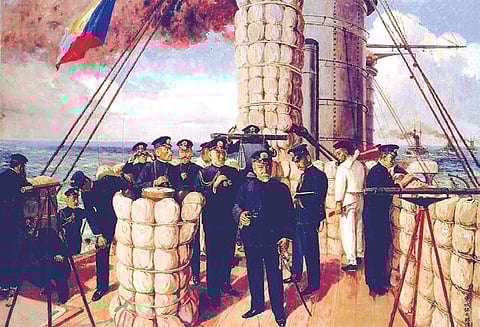
The Russo-Japanese war of 1905 was the start of the Asian long cycle. In 1904-05, the Japanese definitively defeated the Russians after centuries of Western expansionism, colonialism and mercantilism. The battle of Tsushima is famous because after centuries an Asian empire defeated a European one.
In the early 1900s, Europe plus America accounted for over two-thirds of the global GDP. Since the Russo-Japanese War, the West has declined to about one third, whereas the ‘rest of the world’ has climbed to two-thirds. This is what I mean by the long cycle.
The master narrative for Asia changed after 1905 from ‘we are subservient’ to ‘we can overcome’. Asian nations rose sequentially through the long cycle that followed. First, Japan, then Taiwan and South Korea, followed by the Asian Tigers from the 1970s onwards, followed by China. India has been on the rise for over three decades.

A new master narrative was written after India’s independence. It is a miracle that, compared to other emerging independent nations, our multi-ethnic, multi-lingual, multi-religious India has stayed largely democratic and intact, notwithstanding its imperfections. The focus from 1947 till 1991 was to hold together in the face of centrifugal forces. The leaders from 1947 did a superb job of this.
In 1991, with economic liberalisation, the Indian master narrative was rewritten again. What we are seeing since 1991 is the emergent nature of India within the longer Kondratiev cycle of Asian resurgence—growing bigger, showing confidence and impacting the world. This master narrative is likely to continue playing out for a few decades ahead.
The short cycle
During the last 20 years, the Indian stock market has returned over 13 percent of compounded returns in dollar terms, higher than any other large stock market, says Saurabh Mukherjea and Nandita Rajhansa’s book, Behold the Leviathan. The last 30 years’ data would show the Indian stock market has returned handsomely, second only to the US among the world’s 10 largest markets.
The growing infrastructure investments within India and growing investors’ confidence both reflect in increased foreign direct investments (FDI). From about $30-35 billion a year in 2012-13, net FDI inflows doubled to about $70-80 billion in recent years, representing 2-3 per cent of the increasing GDP.
Since 1990, corporate tax rates have declined from about 60 percent to about 25 percent.
So, despite the short-cycle analysis of India’s social and political problems, there emerges a durable story of growth consistently in 30 years since liberalisation.
But truth be told, an annual growth of 6-7 percent will not be sufficient for India to reach the status of ‘developed economy’ in my lifetime. This is so despite a contemporary smugness that India is growing fast compared to all her slowing-down peers.
So, what remains unfinished in India’s agenda?
Per capita income: The focus of India’s efforts must shift from GDP (ranked 5th in the world) to per capita income (ranked around 150th). Increase in per capita income can trigger demand increases with several attendant benefits to the national economy.
Social sectors: India needs a huge uptick into social investments in primary education and public health. Those states that invested more than the national average have forged ahead. Tamil Nadu resembles the Southeast Asian Tigers at present.
Private capital investment: Private gross capital formation has lagged public investment. Ministers have harangued Indian industry to “release the animal spirits”, but corporate action has not followed. It is worth pondering on the reasons.
Job creation: If the above measures (and many others) are undertaken, there is a good chance that new job creation will match the uneven population growth in the country. Already, the South shows signs of importing workers from outside the region.
Uneven wealth creation: India is at the phase of hugely unequal wealth creation. The top 5 percent of the population are on the fast track, while the others are stuck in the slow track.
India is benefitting from a compounding effect over 75 years, not merely the recent decades. We have experienced 50 years of consolidation and 25 years of the economy creating wealth. We now await what our traditional wisdom demands—a phase of uplift for all.
For this, among other things, India needs several SHE—sustainable, humane and enlightened—companies. Depending on a few is not good, especially because some wallow in a strong sauce of viscous controversy.
R Gopalakrishnan
Author whose latest book, co-authored with Harish Bhat, is Jamsetji Tata: Powerful Learnings for Corporate Success
(Views are personal)
(rgopal@themindworks.me)