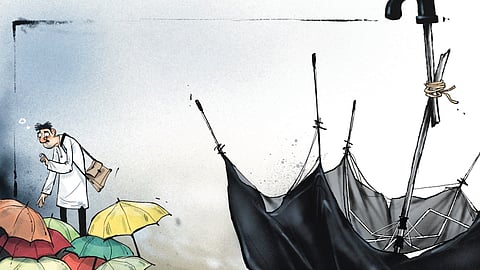

The Aam Aadmi Party’s defeat in Delhi has its way of showing that numbers can create their own narrative. The final result—48 to 22—reveals that the BJP overcame a deficit of nearly three decades in the capital to eventually break the phenomenon of AAP as a ‘miracle party’. But numbers explain little of what happened. We have to go into the political dynamics of election strategies to understand how AAP was domesticated into a mediocre, marginal party that could be discarded. It involved a set of elaborate strategies.
First, the BJP had to break the myth of Arvind Kejriwal, who represented the dream of alternative politics. He was once cited in the same breath as alternative democracy movements. This dream was shattered.
There was a sense where democracy in India was being reduced to elections, and elections to a numbers game. Democracy here becomes functional, mediocre and majoritarian. Kejriwal had offered an alternative myth of politics built around a vision of citizenship, participation and a different vision of the future. The first thing the BJP did was to bifurcate the myths into an iconic Kejriwal more for academic consumption and an everyday Kejriwal caught in the mediocrity of governance and politics.
The central government did it brutally by arresting both chief minister Kejriwal and his deputy Manish Sisodia. It broke the halo of incorruptibility and disrupted the genealogical links to Anna Hazare’s anti-corruption movement. Kejriwal was no longer an immaculate conception, but an everyday invention. The banalisation of Kejriwal began with the arrest and suspicions swirling around it. With the two top ministers in jail, AAP was in no position to claim an alternative political path.
The second strategy is about how the BJP has reshaped Delhi’s image. The city is no longer seen merely as a hub for marginal migrants; it has been redefined as a middle-class dream. Delhi has shifted from a space of marginality to one that echoes the grandeur of Curzon-era Delhi, now reimagined under Narendra Modi’s imperial vision. The city as an imagination has changed. The sociological dreams of migrants have yielded to a more permanent sense of residence.
Delhi can now dream of an instrumental majoritarian politics. To this the BJP added a clever caveat—it pointed out that AAP trying of administer Delhi without the support of the national regime was a futile exercise; as Kejriwal’s opponent pointed out, you need double-engine politics to govern Delhi. You need a party that is in power both at the Centre and in the capital.
Without such a twin order of governance, AAP sounded more like a children’s crusade than a possibility of real politics. The BJP thus altered three myths to break the regime of Kejriwal.
First, it destroyed the iconicity of Kejriwal—he could now be a butt of jokes, as the headline’s proclaimed. The broom, once a symbol of revolution, had become just an ordinary household object. Instead of representing reform and an alternative future, it now blended into the routine of everyday politics—where the BJP played the role of a far more dominant and authoritative figure.
At a different level, BJP also changed the nature of AAP—with two leaders under arrest, the leadership passed to Atishi Marlena, who was definitely idealistic but was new too. She ran a brilliant campaign of resistance, but it was not enough to capture the earlier halo of AAP. It was no longer an integrated party of eccentric and radical individuals; it sounded more like a disparate collection of individuals—each eccentric individually, but adding little to the whole.
What is really impressive is not the result; it was how the BJP created a new myth of politics.
We have to remember that Delhi is no longer seen as a separate entity, a Union territory. It’s seen as a part of the larger forces of politics, where the citizen is ready to settle for a minimum idea of governance. By minimising democracy, the BJP maximised its own possibilities of power and governance.
The results have to seen as expressing logical politics. The defeat of Kejriwal raises a set of questions for the future. Modi has reduced alternative dreams of politics to conspicuous consumption. The question is, how does India reach back to a dream of politics, to the dreams of Jayaprakash Narayan and Anna Hazare. Is it even possible? Here, Kejriwal has to be seen more as a heuristic.
We have to ask two questions. What happens to the future of AAP? And what of the future of the Congress? Both the Congress and AAP were once models of pluralism. They have to be kept alive. But this prospect now seems dismal. Both the Congress and AAP have to become more inventive; both have to break the current realism of politics which has reduced democracy to a drab electoral system.
We have to dream of a new kind of citizenship. One needs memory of a different set of inventions. This is where civil society, NGOs and universities have to return to help create an alternative imagination.
One of the first things that civil society has to do is redream the city. India’s democracy has to become inventive again. One has to go for democracy not as a theory of representation, but as a system of inventions. AAP was a reflection of that trend; we need to create a series of AAPs in each state. For this, the current idea of opposition is too restrictive, too hegemonic, too patriarchal. The Sharad Pawars or Rahul Gandhis won’t do, and Mamata Banerjee is too totalitarian for comfort.
What we need is a more dialogic vision of plurality, where democracy empowers each citizen to become an inventor of new political possibilities. In many ways, AAP’s defeat is as devastating as Donald Trump’s victory—both undermine the idea of citizenship as a space for reimagining political narratives. The fall of AAP serves as a stark reminder that the true hope for politics lies in the dreams of citizenship itself. Clinging to rigid, institutionalised and mediocre politics will no longer suffice.
India now stands at a crossroads: either it succumbs to a majoritarian authoritarian democracy, or it crafts new possibilities, new dreams for the future. To accept AAP’s defeat is to concede the decline of India’s democratic imagination.
(Views are personal)
(svcsds@gmail.com)
Shiv Visvanathan | Social scientist associated with the Compost Heap, a group researching alternative imaginations