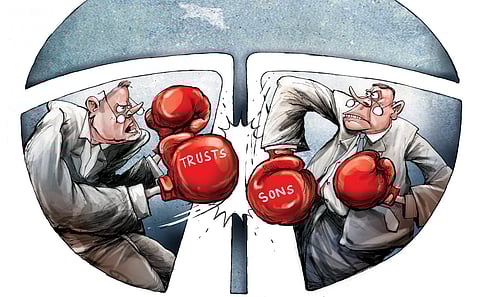

Deep tensions within the immediate and extended family, emotions within the Parsi community, and wars between Parsis and non-Parsis have been part and parcel of the Tata Group’s tumultuous history over the past 150 years. Tata Trusts, the more philanthropic end of the sprawling salt-steel-software empire, owns a majority stake in Tata Sons, the holding firm. So the former’s footprints within the world of profits and boardrooms have always constituted an uneasy ingress, dogging the family for a century. British colonial rulers and post-independence regimes, all have meddled in the Tatas’ affairs.
Hence, there is nothing shocking about the stink that erupted within the Tata Trusts, originating from the feud between Mehli Mistry, a trustee, and Noel Tata, the new heir and the late Ratan Tata’s half-brother. Noel ejected Mehli from the trust, but that set in motion a disruptive cascade that ended up crashing into the Tata Sons’ boardroom. At stake is a tangled web of aggravated relations: among Parsis (Mehli vs Noel), between Parsis and non-Parsis, and within kinfolk (Noel vs the family of the late Cyrus Mistry, his brother-in-law). The group has grappled with such shenanigans in the past, too.
Mehli, who is likely to legally contest his ouster, sees himself as the holder of Ratan’s legacy. He wants a say in all nodal centres across the group. He is peeved that Noel trusts non-Parsis: two are in Tata Trusts, a third is Tata Sons’ chairman. Mehli is Cyrus’s cousin, but supported Ratan during the Ratan-Cyrus spat. It is possible that Mehli dislikes Noel’s recent moves to fix the love-hate relationship with his in-laws.
Implicit in these are three issues. Mehli’s proprietary sense is one. Since the early 1900s, trustees have tussled over this right. In his biography of the group, Mircea Raianu explains how Dorabji and Ratanji, the two sons of founder Jamsetji Tata, who died in 1904, clashed with a cousin, R D Tata. The two sides “faced… momentous decisions about how best to carry on [Jamsetji’s] legacy”; Dorabji’s “conservative instincts” jarred with RD’s “ambitious plans”. It was left to a mediator, Jamsetji’s trusted advisor B J Padshah, to bring the trio together.
In the 2010s, Ratan sidelined Noel and anointed Cyrus as his successor. After the Ratan-Cyrus falling out, a technocrat, N Chandrasekaran, headed Tata Sons. Noel got the opportunity to own and manage the empire only after Ratan’s death.
Relations with ‘outsiders’, or non-Parsis, are another issue. Historically, they have been both welcomed and shunned by the Tatas. Raianu writes that the group “depended on Marwari intermediaries to connect them with the inland markets”. Marwaris “permeated the Tata organisation as selling agents, partners, and shareholders”. But when Tata & Co was liquidated in 1930, the Marwari shareholders were shaken off. The Tatas used the crisis to “enact a clean break” from them. Gone were individuals like Cheniram Jesraj, a Marwari partner since the group’s old opium trading days. Earlier, when Padshah brokered peace between Dorabji and RD, the Marwari agents were excluded to “protect” the Tata name and ensure that it remained “unblemished”.
In the early 1990s, when Ratan took over from J R D Tata, he got rid of outsiders, or corporate overlords who managed the group’s jewels—the steel, auto, and hotel businesses. But after the fight with Cyrus, Ratan again inducted non-Parsis in Tata Trusts. An outsider headed Tata Sons too. Mehli joined during the post-Cyrus period, and Ratan maintained a balance between Parsis and non-Parsis in the affairs of both Tata Sons and Tata Trusts. When Noel took over and leaned more towards non-Parsis, it rankled the Parsis.
Finally, what irked Mehli was an old riddle: Tata Trusts’ influence over Tata Sons and what it ought to be. The prickly and contradictory nature of ties between charities and companies, philanthropy and profits, and public and private interests surfaced as early as 1899. Jamsetji had decided to set up a property trust to settle the family estate and leave adequate money for charity, apart from sufficient funds for his descendants. But colonial laws like the Transfer of Property Act, 1882, barred it.
A raging debate ensued between wealthy Indians and colonial rulers, nationalists and imperialists. Viceroy George Curzon felt that “old Tata (Jamsetji) was… more interested in family endowment”. Sister Nivedita, Vivekananda’s disciple, thought Tata was “willing to risk starvation for his children… to secure benefit to the nation”. Anyway, a trust was registered under the Charitable Endowments Act, 1890, which placed it under official ‘oversight’. Future Tata generations willed their stakes in Tata Sons to the Trusts. Thus, by 1947, the Trusts owned 80 per cent in Tata Sons.
Post-1947, Indian laws banned trusts from owning majority stakes in firms, but exempted Tata Trusts due to “their long record of service to the nation”. But under the Bombay Public Trust Act, 1950, the trustees were passive government appointees “who did not interfere in the relationship between companies and trusts”. This had changed by the time Cyrus, as chairman of Tata Sons, alleged that Ratan, chairman of the Trusts, influenced the group’s day-to-day operations.
This initiated a fresh debate on whether trusts should or could wield decision-making powers over firms. Tata Trusts continued to appoint directors on the Tata Sons’ board and gave them veto powers. This proved to be the breaking point between Mehli and Noel, when the former, who wanted to join Tata Sons as a director, opposed Noel’s nominee. In an oblique manner, the present bustup links to the Noel-Cyrus family issues.
Tata Sons needs to launch an initial public offering due to RBI rules. This can disrupt the Trusts’ hold over Tata Sons due to mandatory regulatory disclosures. Cyrus’s family, which owns a substantial stake in Tata Sons, wants an IPO to sell shares and pay its debts. This is why Mehli was unhappy with the prospects of an amicable deal between Noel and Cyrus’s family.
Mehli’s exit may mark the beginning of a legal war, as he is likely to contest his exit from Tata Trusts. Legal delays, however, may provide a breather to Noel to make Mehli powerless. As Raianu recently told the BBC, the Trust-Sons events reflect the “resurfacing of unresolved business”.
Alam Srinivas | Journalist and author of Storms in the Sea Wind and IPL: An Inside Story, Cricket & Commerce
(Views are personal)