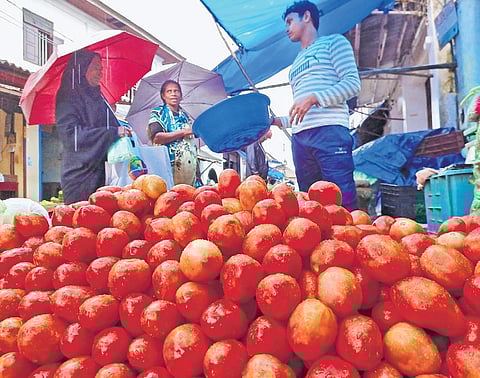

The skyrocketing prices of vegetables and grocery items have broken the national capital region’s back this past week. Essential commodities like vegetables, spices, pulses, fruits, dry fruits, edible oils and others are being sold at a rate at least four times the selling price. Spiraling prices of tomato since last few weeks has left the city households bleeding. The effect can also be seen on other vegetables and essential commodities required to run a household kitchen where prices have increased manifold with little hope of it being restored in the near future.
The wholesale markets are witnessing up to 66% reduction in supply thus causing price rise of up to four times the selling price on retail. Market analysts claim that the drop in supply of goods is due to the incessant rain. Experts in market analysis, farmers’ associations, shopkeepers and traders claim that the crisis is bound to get worse in coming days as authorities have taken limited action to alleviate the hardships faced by the residents.“Crucial elements for a well-rounded meal now impose a severe strain on the average individual’s financial resources. Over the past year, the prices of these items have experienced a two to three-fold spike. This upward trajectory shows no sign of abating in the foreseeable future due to supply shortages,” said Omprakash Gupta, a Nangloi-based market analyst.
Earlier, Delhi wholesale markets were getting supply from across the country but as the crops have been damaged by rain, the supply has been drastically affected. Many states that were earlier sending consignments to the capital are now catering their local markets leaving the region in misery.
Spotlight on tomatoes
“We were getting tomatoes from Himachal Pradesh, Rajasthan, Uttar Pradesh, Haryana, Maharashtra, and south India but now since rains have marred the production we are totally depended on Shimla, Himachal Pradesh. In this crisis, we have little hope that any other state will supply tomatoes to Delhi mandis by ignoring their local market needs. At this crucial junction, we are receiving tomatoes on a rate of Rs 80-90 per kg in the wholesale market and supplying by adding our profit besides other expenses to the retailers. The consumers, who are at the receiving end, are forced to purchase the same product between Rs 140 to 180 per kg depending on quality of tomatoes,” said Manoj Kumar, a Noida-based market analyst.
Rajendra Sharma, former chairman of Agricultural Produce Market Committee, said unseasonal rains have affected agricultural production and the situation has now become critical. “The market is volatile these days due to the sharp decline in the supply. As onions and potatoes can be stored for a longer duration, we have control over their prices, but we cannot store green vegetables for even a small period of time due to a lack of proper cold storage. Hence, there is no control over the prices of these products. In Asia’s largest wholesale market, Azadpur Mandi, wholesale prices of onion and potatoes are still below Rs 20 per kg and storage is also better. States like Uttar Pradesh, Punjab, Rajasthan, Maharashtra, and Madhya Pradesh were our major suppliers which have almost stopped supplying green vegetables as now trucks of potatoes and onions are coming from there,” he said.
“The government earlier hiked fuel prices, particularly diesel, which resulted in a broad-based surge in prices and now unprecedented rains have ruined the market. Surprisingly, no measures have been taken to alleviate the plight of severely affected consumers,” he added.
Prices of other vegetables are on fire too
A visit to Delhi’s wholesale and retail markets also reveals how the consumers have been abandoned and the reason why essential kitchen items are going off their menus. As far as fruits are concerned, prices of the majority of items have registered a manifold increase.
For instance, good quality mango is being sold above Rs 100 per kg while banana is available for Rs 90-100 per dozen. One kg papaya is being sold above Rs 90 while one piece pineapple is being sold at Rs 90-120. Apple prices are varying between Rs 100-150 per kg in the retail market and grapes are available for nearly Rs100 per kg.
It also emerged that the prices of essential grocery items have shot up and families facing hardships to run their kitchen. Prices of pulses are around Rs 200 per kg in the retail market whereas the price of
mustard oil varies between Rs 150 and Rs 160 per litre in and around Delhi.
Wheat flour is being sold above Rs 60 per kg, medium quality rice Rs 70-100 per kg and in spices, red chilli powder is available at Rs 75-90 per 100 grams. Even during the non-peak season, eggs are available at a rate of `8-18 per piece. Similarly, chicken is being sold at a rate of Rs 220 per kg and mutton is above Rs 750 per kg in the local markets.
The market turmoil has compelled families to exclude many items from their daily menus, with lower-income households bearing the brunt of the impact. Umesh Gupta, a trader said, “Products like almonds, cashew nuts, walnuts, pistachios, raisins, and pine nuts are experiencing reduced demand compared to previous years. Customers frequenting our shops seek more affordable options and inquire about when the prices will witness a decline. As traders with families of our own, we empathize with the situation.”
Walnut is available at a rate of nearly Rs 800-1000 per kg, khumani (naturoz) nearly Rs 100 per kg, almonds Rs 850-1000 per kg, cashews Rs 250 for 100 grams, good quality dates Rs 400-600 per kg, munakka Rs 600 per kg, kishmish at Rs 450 per kg, anjeer nearly Rs 1100 per kg, and flax seeds nearly Rs 350 per kilogram.
Heatwave, high rainfall behind spike
Farmers and traders attribute this extreme price hike to a combination of several factors including intense heatwave followed by intermittent rainfall in recent days has disrupted the vegetable supply chain. This erratic supply has created shortages in the market, leading to a surge in prices.
“Surge in the costs of vital commodities, including milk, spices, vegetables, pulses, edible oil, non-vegetarian items and eggs, has besieged lower-middle-income families and those vulnerable to economic fluctuations. The exorbitant prices of basic necessities have burdened households already grappling with the escalating fuel costs, leaving families of all social standings struggling to maintain their day-to-day affairs,” said Ranbir Singh, an office bearer of Kisan Sangharsh Samiti.
India’s consumer price index (CPI) inflation eased sharply to 4.25 per cent in May hitting a 25-month low and came under the Reserve Bank of India’s upper tolerance limit of 6 per cent for the third straight month. May’s retail inflation declined from 4.7 per cent recorded in April 2023 and 7.04 per cent in the year-ago period.
As India lacks climate contingency plans for key food crops and food security, leading to anarchy in the open markets, ultimately the consumers bear the brunt of this situation. The country’s special contingency plans and safeguards should focus on, firstly multi-stakeholder meetings with farmers, traders, farmers’ organizations, mandis and transporters for a wholesome view.
Secondly, the government should invest in infrastructure development of cold storage at the block or village levels, supported by solar dryers and cottage-level processing plants. Farmers should be encouraged to utilise drying facilities to extend the shelf life of their harvests.
The third step should be on improving the connectivity from hilly areas like Himachal Pradesh, Uttarakhand and Kashmir. Train connectivity to these regions can facilitate major off-season production.
Heatwave, intermittent rainfall culprits?
A visit to Delhi’s wholesale and retail markets also reveals how the consumers have been abandoned and the reason why essential kitchen items are going off their menus. As far as fruits are concerned, the prices of the majority of items have registered a manifold increase. Farmers and traders attribute this extreme price hike to a combination of several factors including intense heatwave followed by intermittent rainfall in recent days has disrupted the vegetable supply chain.
