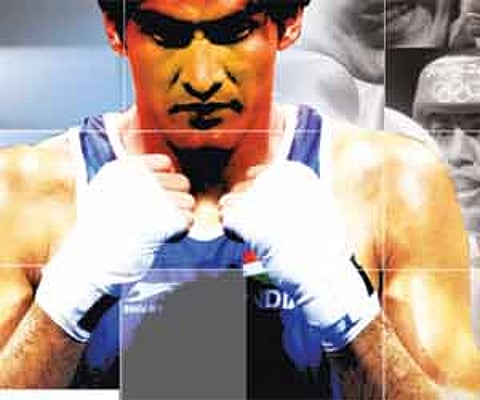

VIJENDER Singh's bronze medal at the Beijing Olympics has been followed by bronze medals for Jitender Singh, AL Lakra, Dinesh Kumar and Akhil Kumar at the Boxing World Cup held in Moscow. The magnitude of this medal haul can be gauged from the fact that PV Devarajan’s bronze in Bangkok in 1994 was the only medal India had won at the World Cup prior to Moscow 2008. Indian boxing can claim to have arrived on the world stage.
Not that the sport was non-existent earlier, or that talent was in short supply; it’s only that boxing heroes were elusive. All that has changed now. The medals won at the Olympics and World Cup will not only motivate this country’s neglected boxers to continue their battle for survival, but also inspire aspiring boxers to emulate the feats of today’s heroes.
change in script
Even before Vijender's surge in Beijing, India had produced boxers of note — the late Hawa Singh, Rajinder Singh Yadav, Devarajan and Dingko Singh. All these boxers have contributed to the popularity of their sport but, unfortunately, the interest generated was never sustained and neither did it translate into medals. This was probably because no achievement brings with it the stardom that an Olympic medal can. Therein lies the worth of Vijender's feat.
If Vijender heralded a new dawn for Indian boxing, Akhil and Co, with their record-breaking show in Moscow, have brought to the fore the depth of the talent in the country. National boxing coach Gurbax Singh Sandhu is understandably optimistic about India’s future in boxing. “There is still a long way to go for them to reach the level of Cuban and Kazakhstan boxers, but if we groom our young boxers properly, they will be potential medallists at the 2012 Olympics. The Asiad and Commonwealth Games in 2010 will provide a chance to judge their improvement,” he says.
the bhiwani factor
It is not a coincidence that, apart from Lakra, the rest — Vijender, Jitender, Akhil and Dinesh — hail from Bhiwani, a place referred to as Little Cuba because of the numerous boxing clubs that dot this district in Haryana. At the Bhiwani Boxing Club, aka BBC, there are at least a dozen clubs run by former boxers who train almost 700 youngsters. The average age of enrolment is 12. The BBC, a Sports Authority of India (SAI) training centre, has an imported boxing ring worth Rs 10 lakh. BBC products have won 165 international and 312 national-level medals. Over the past few years, the number of trainees has increased ten-fold.
“In Bhiwani, boxing is a way of life. Many youngsters are taking boxing seriously after Vijender's Olympic bronze. If you ask a boy in Bhiwani about his ambition, he is likely to say that he wants to emulate Vijender. If we can tap the potential of such youngsters, India can be a world-beater,” says Sandhu.
helping hand
The spine of the BBC is SAI coach Jagdish Singh, who keeps himself up to date with the latest coaching methods. Jagdish collects video footage of boxing legends and, when he explains the intricacies of technique to his wards, the visual depiction of various moves makes it easy for his students to follow him. While the staple diet of boxers at the BBC comprises milk and curd, the training regimen, involving running in the countryside desert twice a week, is taxing. Boxers are encouraged to fight without chin guards — a method that helps youngsters become both skillful and tough.
Jagdish also ensures that there is camaraderie among his trainees. “Rivalry should be healthy and confined to the ring. All my trainees are good friends and share a very good rapport,” he elaborates.
wanted: more money
Realising the potential in Bhiwani, Haryana CM Bhupinder Singh Hooda has announced plans to further improve the facilities at the SAI centre. On the lines of the Australian Institute of Sports, the BBC will be equipped with state-of-the-art facilities including a new building, a gymnasium, and a nutrition and therapy centre. The state government has sanctioned Rs 30 crore for the development of boxing, with Kaluwas and Devsar being made model villages.
With the Mittal Champions Trust already funding the diet, equipment, medical rehabilitation and foreign training of Bhiwani boxers, Jagdish has reason to be optimistic. “Most of the boys at the boxing centre are from villages. They are rough and tough and never complain about the infrastructure and facilities. But give them better infrastructure and they will deliver better results,” he says.
tapping the talent pool
Apart from Bhiwani, there are pockets in the North-East, Punjab, Uttar Pradesh, Rajasthan and Kerala where there is appreciable interest in boxing. Such boxing nurseries need to be identified and nurtured; otherwise, boxing could meet the fate of hockey. “We have shown that we have the talent, but the important part is to transform this talent into substantial results. For that, long-term planning and infrastructure are required. Unfortunately, too much bureaucracy has crept into the boxing administration and that is hampering the development of the sport,” says Jagdish.
Tamil Nadu’s fall in boxing is a pointer to how negligence can damage the sport. Chennai was once a major boxing hub, but it has failed to produce a quality boxer since World Cup bronze-winning Devarajan hung up his gloves. Inadequate infrastructure, fading interest, limited job opportunities are a few of the reasons responsible. “There are no takers for boxing. The case of Senthil Nathan explains why. Despite winning four state championship titles, he was unemployed and had to give up boxing. If this is what happens to a champion boxer, imagine the plight of the rest,” explains Devarajan, an Arjuna awardee. The Tamil Nadu Boxing Association (TBA), on its part, points to the shortage of funds and, consequently, infrastructure. “Nothing is possible without funds. In the absence of funds, our training facilities and equipment are obsolete. We don’t even have a decent boxing ring. No matter how talented a boxer is, he cannot make a mark at the international level without modern equipment,” says Devarajan.
time to consolidate
With Indian boxers proving their worth at the Beijing Olympics and the World Cup, the Indian Amateur Boxing Federation (IABF) should build upon the growing popularity of the sport and ensure that India becomes a force to reckon with. What is needed now is consolidation.
sandipgopal@gmail.com