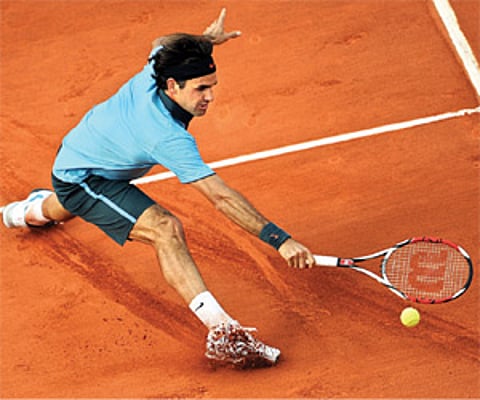

And we were worried that his career-defining climb to the summit had been halted, perhaps forever. We were worried by the frequency with which he was losing matches to opponents who would not have dared to dream of such a possibility two seasons ago. We were worried that his halo had been damaged beyond repair. We were worried that defeat after defeat at the hands of his nemesis, Rafael Nadal, would trigger in him an emotional freefall. We were worried that he had become a bitter man who questioned line decisions, raged against his failings and misfortunes and cried without control on the court. We were worried he would start paying attention to commentary box gurus and armchair experts dispensing technical advice.
Undoubtedly, he too would have spent hours worrying about the status of his game and his status in the game. But he never lost faith in himself. And he never stopped believing that he would overcome the demons, psychological and physical, real and imagined, standing in his path.
Return of the king
The background: A man caught in the centre of the internal pressure of his own inconsistency, the external threat of Rafa’s apparent invincibility and the ever-increasing attention sought by his weary body and blossoming personal life. And yet a man who begs to differ with a critical world with the words: “But I have always believed in my chances to win at Paris or any Grand Slam.”
The plot: A fortnight in Paris during which “I was in desperate situations; there were moments when I was so close to losing”. A final he describes as “the match I’ve been waiting for all my career”. A never-before opportunity to claim the crown he craved for almost ruined by moments when his “mind kept wandering” and he was tormented by thoughts of “what if”. Ultimately, “I handled it all”.
And he himself rewrote his destiny with the lines: “It was probably my greatest victory. I was under tremendous pressure. I did it and it’s phenomenal.” The acclaim for his emotional landmark triumph at Roland Garros could not have been more individual… and universal.
Everybody loves a great comeback story. Roger Federer is a bestseller.
Fortune favours the brave
He is 27, the joint holder of the all-time record with 14 Grand Slam titles to his name, one of only six players to have won all four majors, and one of the greatest players, if not the greatest, in the history of tennis. If there is anything new to be said of Roger Federer, then the world is yet to know of it.
Were it the intention to generate undiscovered details about his exploits for those who seek in the beautiful game of this Swiss artiste the enrichment of their experience as spectators, this would be a most unsatisfactory state of affairs.
For those who have become almost compulsive in seizing every possible opportunity to scrutinise Federer’s greatness, his latest Grand Slam trophy — the Coupe des Mousquetaires won on the terre battue of Court Philippe Chatrier at Stade de Roland Garros — comes with an inescapable caveat: He didn’t beat Rafael Nadal.
Questions: Does that devalue his achievement? Will history place an asterisk against his trophy?
Answers: He didn’t select his opponent. The French Open title is the French Open title — even if Robin Soderling, the man on the other side of the net, had never previously progressed beyond the third round of a Grand Slam tournament, has never won a claycourt title and, until his unforgettable Paris fortnight, during which time he demolished Clay King Rafa, was known more for his perceived disregard for higher-ranked players than his actual ability to defeat them.
To credit circumstance for Federer’s success at Roland Garros would be to belittle the uncompromising effort he has invested. In his own words: “We need to use luck when it’s there. Look at how I practise so hard, thinking I’m doing all this for Paris, for Roland Garros. Everything came in at the right time.”
Nothing can tarnish Federer’s self-proclaimed greatest moment. Winning takes care of everything — including questions.
Great, greater, greatest
Is Roger Federer the greatest tennis player of all time? If number-crunching is to be the sole yardstick, the man perched alongside Pete Sampras at the top of the pecking order with 14 Grand Slam titles in the Open Era is beyond argument the champion of champions. Moreover, in the opinion of many of his contemporaries and legends of the past, Federer stands alone. The debate, however, doesn’t necessarily end there.
In 1986, the magazine Inside Tennis polled 37 experts in a computerised tournament. Rod Laver topped the list ahead of John McEnroe, Don Budge, Jack Kramer, Bjorn Borg, Pancho Gonzales, Bill Tilden, Jimmy Connors, Fred Perry and Lew Hoad.
In a poll conducted by the Associated Press in 2000, Laver was voted ‘The Male Tennis Player of the Century’ ahead of Pete Sampras, Tilden, Borg, Don Budge, John McEnroe and Hoad (tied), Rosewall and Roy Emerson (tied), and Kramer.
In an article in Tennis Week in 2007, tennis historian Raymond Lee used statistical analysis to arrive at the following sequence: Laver, Tilden and Borg (tied), Roger Federer, Gonzales, Rosewall, Budge, Ivan Lendl, Connors, Sampras, McEnroe and Kramer.
Much as the evidence presented above tilts the verdict in Laver’s favour, the Australian himself refuses to be anointed Greatest Of All Time (GOAT). In Laver’s view: “I don’t think you can compare eras. You can be the dominant performer of your time, but I don’t think anyone has the title of best ever.”
According to Ivan Lendl: “I think the only conclusion you can reach right now is to split it: Federer in the modern era and Laver from 1968 and back. But if Roger wins the next two or three, well, maybe you give it to him.”
Over to Federer: “I think it should be judged at the very end. How well did I do? Good? Great? Very good? Or medium? It’s for other people to decide. Right now, I’m still playing. I haven’t retired, and I think I still have many more tournaments to go and many more Grand Slams. I’ll give it my best shot to have the best possible career. I hope I can maintain the records I have and I hope to break some other ones along the way. I hope to stay healthy. That’s most important because motivation is not a problem for me.”
a challenge for a champion
Roger Federer’s greatness — or, for that matter, that of all those rare sportsmen whose worthiness is not limited to the era in which they dominated — isn’t confined to the number of records broken and titles won.
Appreciation of Federer’s impact on tennis goes beyond statistics. In this age of nuclear-warhead racquets and bazooka baseline shots, the weapons of his game are subtlety and sophistication. Federer in full flow satisfies one description: Artiste. Unconvincing though this might sound to the skeptical, winning and artistry are rarely compatible in the power-dominated arenas of modern-day sport. Viewed with this perspective, he is a rare exponent of tennis. Viewed in the context of statistics and expert opinion, he is in elite company.
In any discussion on the Greatest Of All Time, this man, as gifted a player as any tennis has seen, certainly has a case. And yet, the more relevant question would be: Is Roger Federer the best in the business today?
Ranked No 2 in the world, he trails Rafael Nadal 7-13 and Andy Murray 2-6 in head-to-head encounters. To state the obvious, he who has been identified as one for the ages would seek to set the record straight — more for his own satisfaction than that of anybody else.
Will his triumph at Roland Garros ignite another span of sustained dominance? Sport being famous for proving predictions wrong, the final verdict on Roger Federer will perforce have to wait. Yet, this much is certain: his story will continue to be a bestseller.
siddharthamishra@epmltd.com