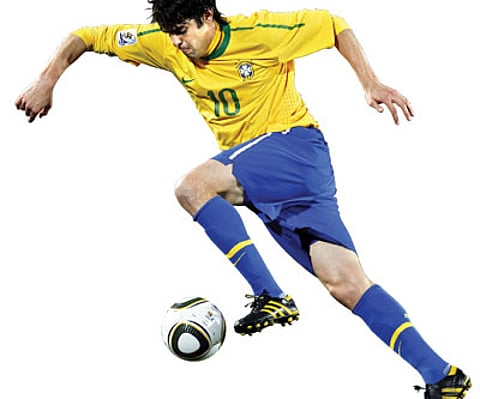

Santos, the Brazilian club that Pele served with unmatched loyalty and distinction, announced the ‘retirement’ of its No 10 jersey after the ‘Black Pearl’ bowed out of the game. Such is the aura of this number. But how did number 10 come to acquire a position of esteem in football? Pele’s exploits undoubtedly immortalised the number but when the Brazilian legend initially wore that jersey it was not on account of being the best player in his team but because he happened to start at inside-left.
In earlier times, convention dictated that jersey numbers start from the goalkeeper, who wore number 1. Then, players from right wing back to left wing back take up numbers 2 to 5 in a 4-2-4 formation. Midfielders wear jerseys numbered 6 and 7, the right-winger No 8, inside-right No 9, inside-left No 10 and left-winger No 11.
In Sweden 1958, the World Cup in which Pele made his debut, it was Gilmar in goal; Bellini, Djalma Santos, Nilton Santos and Zito in defence; Zagallo and Didi in midfield; and Orlando, Vava, Pele and Garrincha in attack. With the then 17-year-old Pele sparkling like no other player could, the No 10 jersey soon came to be identified with him — and elsewhere, the best player in the team.
Over the years, even as formations in football have changed like designs in a kaleidoscope, the jersey-numbering system has also undergone significant changes. So much so, the best player in a team, be he a forward or attacking midfielder, is automatically handed over the No 10 jersey. But with no set system in place, unlike in the past, there might come the day when the goalkeeper sports the No 10 jersey.
Over the years, great names of the game — including Diego Maradona (Argentina), Michel Platini (France) and Zinedine Zidane (France) — have come to be associated with the No 10 jersey. The prominent No 10s to have featured in this World Cup are Lionel Messi (Argentina), Kaka (Brazil), Wesley Sneijder (Netherlands), Diego Forlan (Uruguay), Wayne Rooney (England), Lukas Podolski (Germany) and Cesc Fabregas (Spain).
