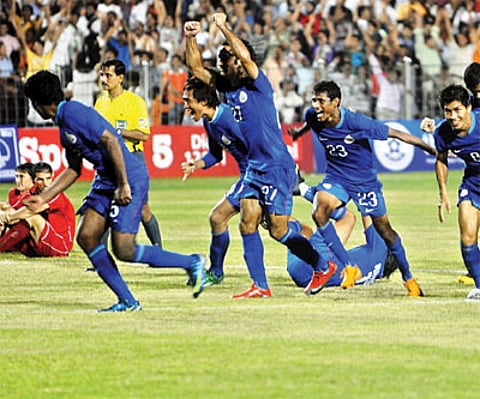

The first Asian nation to make it to the football semifinals of the Olympic Games, at Melbourne in 1956, India was also the winner of the Asian Games football gold in 1951 and again in 1962 with a bronze medal coming in 1970. In the interim, India emerged runner-up to Israel in the 1964 Asia Cup. These are noteworthy achievements in Indian football, as is the 1-1 draw against France in the 1960 Rome Olympics. But since the 1980s, there has been a general decline in the standard of play.
Apart from winning the SAF Games gold medal, the SAFF Cup and the Nehru Cup tournament, that too against opposition that can only be described as mediocre, the national team has done little of note to be counted among the top nations in the continent. However, there now exists an opportunity to get back on track.
Tough test
After making it to the final rounds in 1984, India has managed to eke out a berth in the final rounds of the 2011 AFC Asian Cup. At this level, there are no soft teams or matches. Ground reality bears this out: in Group C, India has been clubbed with Asia’s No 1 football team Australia, which joined the AFC in 2004, the No 3 team in the continent, South Korea, and the No 7 team, Bahrain. Ranked No 23 in Asia and No 142 in the FIFA rankings, India is the lowest-ranked of the 16 nations in the fray in this tournament.
Qatar presents a good opportunity for the Indian team to redeem its lost glory in Asia. What the players can hope to achieve is suggested by the innovative idea of the organisers to have all the team buses painted in the national colours of the teams with special slogans to match. The slogan on the Tricolour-painted Indian team bus reads: 11 Players, A Billion Heartbeats. It is not without reason that football followers in the country are hoping that the team doesn’t disappoint. At the same time, it would appear as if preparation for this tough tournament could have been better.
Planning problem
Though three years have elapsed since India qualified for this tournament, the strength of the playing XI and supporting bench strength has failed to convince many. Similarly, decisions taken by the team’s English coach Bob Houghton remain questionable. Citing poor training facilities in India, Houghton got the All India Football Federation (AIFF) to hold camps for the team in Dubai, Portugal and Spain.
While Houghton would have his own reasons for choosing these faraway destinations for practice, critics argue that training on the same ground as the Barcelona stars won’t endow Indian players with the same level of playing skills.
Again, the friendly matches arranged by Houghton against second and third division clubs in these countries have been slammed as meaningless as the team’s strength can never be really tested, or its weaknesses identified for corrective measures to be implemented, against such opposition.
Another area wherein the team has faced criticism is its continued reliance on veteran players like skipper Baichung Bhutia, Deepak Mondal, Mahesh Gawli, Surkumar Singh, Climax Lawrence, Rennedy Singh and Abhishek Yadav, each of whom has been around for at least a decade.
While these players remain committed and competitive, their reflexes and fitness levels are no longer what they once were. Nurturing players from the under-23 team and phasing them into the national squad over the past three years would have helped build a playing XI with a mix of junior and senior players, youth and experience.
Ground reality
Where then does the Indian team stand in terms of ability at the Asian level? For starters, goalkeepers Subrata Paul, Subhasis Roy Chowdhury and Gurpreet Singh Sandhu look competent enough.
However, the defence, with veterans Surkumar Singh, Mahesh Gawli, Deepak Mondal, Rennedy Singh and Syed Rahim Nabi appears rather brittle when viewed in the context of the attacks it will have to deal with. Steven Dias, NP Pradeep, Climax Lawrence, Clifford Miranda, Mehrajuddin Wadoo and Baldeep Singh form the engine room. This midfield line-up is better described as defensive rather than attacking. Skipper Baichung Bhutia, struggling with a calf injury, Sunil Chhetri, Abhishek Yadav and Sushil Singh form the line-up in the Indian attack. Without adequate support — and even with support — Baichung & Co will be hard-pressed to score against opposing teams that are superior in terms of ranking, ability and strategy. In this situation, the Indian team will look to defend in numbers and ensure that it does not concede too many goals even as it attempts to find the net. As former India captain Chuni Goswami says: “Houghton will have be defend with nine players in front of the goalkeeper with just one attacker.”
Realistically speaking, the team is not expected to win against any of the other sides in its group; the players would do well to draw games or keep the margin of defeat as slim as possible. Of course, surprise results can never be ruled out and should Team India defy the odds, it will be a significant achievement.
sports@expressbuzz.com
