
GREATER NOIDA: Too often over these past few weeks we have been preoccupied with the destination. Let us not forget the journey. As much as the story of the inaugural Indian Grand Prix assumes tangible dimensions in the here and now of the Hermann Tilke-designed racetrack at the Buddh International Circuit, it is in 1904 — a sepia-tinted time when the world was 107 years younger and the Motor Union of Western India conducted the first ever competitive event for automobiles in this country — that the all-important small step precipitating the proverbial giant leap of faith lies. It is in this aforementioned journey, with ancient Ford and Rolls Royce masterpieces driven along 1,300 km of terrain connecting Delhi with Bombay in a race held at the behest of Lord Curzon that India’s wheel of fortune in motor-sport was sent rolling.
While it would be an exaggeration to state that motor-sport on these shores was subsequently powered into overdrive, there being no governing authority or rules and regulations in place for progress to exceed incremental spurts in ambition, there was — significantly — no shortage of enthusiasm. Thrills on wheels enjoyed the patronage of the moneyed in Bombay, Calcutta, Madras and Bangalore, the momentum continuing in the aftermath of World War II with discarded airstrips in Juhu, Barrackpore, Sholavaram and Yelahanka being recreated as racetracks and the Deccan Motor Sports Club in Pune hosting events towards the latter part of the epochal decade in which India’s long struggle for independence bore fruition.
Inevitable amidst such ingenuity was the adoption of a formal structure for racing activities and it is to Sholavaram — on October 25, 1953 — that goes the honour of staging India’s maiden organised motor-sport event — five-lap races for motorcycles and sports cars, a three-lap relay for motorcycle teams and a four-lap handicap relay cars enlivening the proceedings. In that the Madras Motor Sports Club (MMSC) came into existence the following year with GM Donner (president), KV Srinivasan (treasurer), K Varugis (secretary), Rajkumar of Pithapuram, Raja DV Appa Rao, H Dye, P Mathen, KA Sillick and Rex Strong (committee members) as founding office-bearers, an administrative foundation was laid for the structure in existence in today’s time. Of those who furthered growth in this context and eventually essayed prominent roles in the formation of the Federation of Motor Sports Clubs of India (FMSCI) in 1971 were Gopal Madhavan, Indu Chandhok, Jayendra N Patel, Anil Bhatia, C Prabhakar and S Muthukrishnan.
In the intervening years, Sholavaram ticked away as the pulse of motor-sport in India, the inaugural all-India competition held at this venue on February 17, 1957 with speedsters from Ceylon and Bangalore growing in stature with participants from various parts of the country joining forces in later years along with imported vehicles of impressive pedigree.
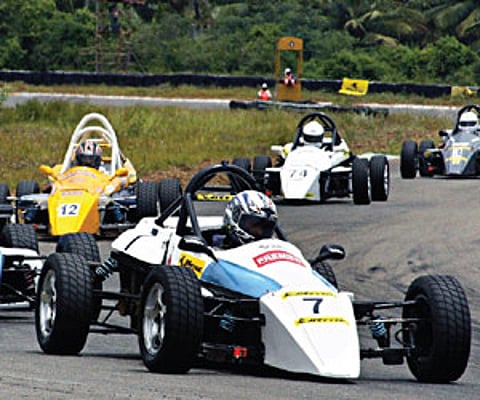
The next stage in the process of evolution was the development of what is described as the Formula India car — the first attempt being made by Kinny Lal and Suresh Kumar of Calcutta who used an Ambassador engine for the purpose and named the machine ‘Qumari Special’. Subsequently, Adi Malgam created a frame that allowed Vicky Chandhok of Madras to develop an indigenous racing car with a Herald engine, and Suresh Naik of Bombay experimented with his own variations.
Among the prominent drivers on the racing scene in those exciting times were Dr Rossi (Ferrari 365 GT), Vijay Mallya (Formula 1 Team Ensign), Mahrajkumar of Gondal (John Surtees Formula 5000), Sundaram Karivardhan, (Chevron Formula Atlantic) and Vicky Chandhok.
After years of persistence and encouraging, if measured, success, it was in the 1980-90s that the graph rose decisively. Together with the full-throttled entry of MRF and JK Tyres into motor-sport, the contribution of S Karivardhan, who pioneered such innovations as a single-seater with a Maruti 800 engine dubbed as India’s Formula Ford and a two-seater car named McDowell 1000 that made use of a Maruti Gypsy 1.0 litre engine during an inspirational career tragically cut short in full flight by an aircraft crash when he was 41, elevated Indian motor racing to hitherto unattained levels of popularity. Complementing these winds of positive change was the forced shift in action from Sholavaram to Irungattukottai in 1990 due to bureaucratic problems and the foray of Akbar Ebrahim into the British Formula 3 Series. Entering the new millennium, the creation of a new breed of Formula cars and inauguration of a racetrack in Coimbatore — the Kari Motor Speedway — by businessman B Vijaykumar served to mark continuity in growth.
It is against such a backdrop that motor racing in India — where rallying has always been keenly-contested and karting is an ever mushrooming sport — witnessed the rise of Narain Karthikeyan, who, in 2005, became the first from this nation to enter the rarefied air of F1; and Karun Chandhok, who emulated his compatriot in 2010.
Indeed, it was in the mid-1990s that dreams of an Indian Grand Prix first assumed shape, the interest evinced by F1 supremo Bernie Ecclestone in this regard fuelling hope that such an aim could be realised. That the process of actualisation consumed nearly a decade and a half since plans to bring the hottest four-wheeler race on the planet to Calcutta first surfaced in 1997 — a site in Salt Lake City being earmarked for the purpose — is due to a variety of reasons unrelated to the suitability of the venues that were successively under consideration.
Consequently, there ensued a series of misadventures involving Bangalore, where 600 acres of land near the airport was examined; Hyderabad, on the outskirts of which 1,367 acres of land near the village of Gopanapally was identified and a seven-year pre-agreement signed in December 2003; and Mumbai, which emerged as a contender in 2004 with Gorai and Navi Mumbai as possible alternatives. While the Hyderabad project reached a dead end due to a change in government and, resultantly, policy, the site being converted into an IT park, the Mumbai option was deemed by the authorities as a waste of money that could otherwise be utilised for more worthy causes.
Other locations considered — New Delhi (for a street circuit), Lucknow and Chennai — were similarly rendered unviable, whether due to problems of logistics or the high cost of constructing and securing sanction for an F1 facility. Adding another sub-plot to the script was the announcement in June 2007 by the Suresh Kalmadi-led Indian Olympic Association (IOA) that it had signed a provisional agreement with Ecclestone for India to host its first ever Grand Prix in 2009 with the track developed in Gurgaon. Realisation that the expenditure attendant upon such grandstanding would be in the region of $400 million subsequently led to backtracking by the IOA and the agreement dying a natural death.
What has occurred since then has been well chronicled. The Jaypee Group has bridged the gap between aspiration and action by constructing the Buddh International Circuit in Greater Noida and staging a race awaited for generations… 107 years after motor-cars of another era had unintentionally commenced a tryst with destiny.
Years from now, when we look back on the past, we will realise that the teams and drivers on the podium made but headlines. And the inaugural Indian Grand Prix made history.
