
First the bizarre. Ronaldo, then the most prolific striker in the world, was omitted from the first team-sheet by coach Mario Zagallo. The ankle injury he had sustained in the semifinal against Holland had apparently aggravated. The coach was even supposed to have pep-talked to his teammates by reminding them of their triumph in the 1962 World Cup, wherein Pele missed the final. Then, minutes before the kick-off, Zagallo issued a revised team list and the Fenomeno was to start.
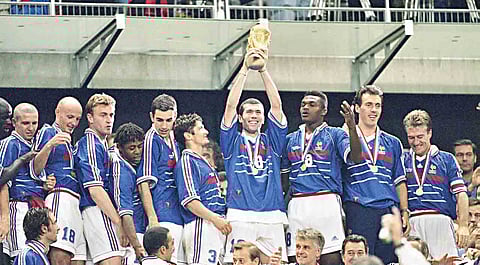
But whatever the logic behind his omission and then the thinking that led to his reinstatement, it was a gamble that went awry. For Ronaldo cut an unspectacular figure, an imposter of the glorious poacher he was, enduring the worst day perhaps of his career. Brazil, the overwhelming favourites, surrendered 3-0, and the French, who last played in the 1986 World Cup, prevailed in what turned out to be one of the most one-sided finals ever.
Among the conspiracy theories that flew around were that Brazilian Football Confederation and his sponsors Nike had a contract before the World Cup that he was to play the final and that Brazil’s players received bribes, the promise of Brazil hosting the 2006 World Cup, and an easy passage in the 2002 World Cup to throw the game. Also were rumours that he was drugged, he had a secret medical problem and that the doctors had accidentally injected a palliative instead of a painkiller.
Next the sublime. Skilful, graceful, yet not acquired the pedestal of the greats, Zinedine Zidane stamped his redoubtable class on the contest, producing a masterclass of silken aggression. The build-up rendered more drama to his legend. Zidane was sent-off against minnows Saudi Arabia, for an impetuous stamp, in the group stage and was ineffective for most part of the tournament.
But as legends often produce, he stepped up to the occasion in the final. Right from the start, he was at the peak of his penetrative prowess, conducting the orchestra for the French. In the 27th minute, he scored France’s first goal, unusual as it came through a header. He added to his own and France’s tally at the stroke of half-time with another header. Thus was born Zizoumania, and France romped home 3-0 to their maiden title.
Brazil and Ronaldo sulked. The scandal over his injury only got murkier and Zagallo was shown the door. A tournament wherein he was supposed to sparkle, and sparkle he did, ended in tears, mystery and humiliation.
Four years later, he shed tears again. But of a different kind, as he took revenge on fate, spearheading his team with a brace over a plucky German side, led by the indefatigable Oliver Kahn, in the final of the first World Cup in Asia.
Remarkably, co-hosts South Korea, coached by Guus Hiddink, became the first Asian side to reach the semifinals of a World Cup, though their dream run was specked with controversial refereeing decisions in each of their knockout match. In the second round fixture against Italy, the latter were denied a Damiano Tommasi’s legitimate “golden” goal before playmaker Francesco Totti was red-carded for diving when replays clearly showed he was pulled down by defender Song Chong-gug. Minutes later, Ahn Jung-hwan tucked in the winner for Korea.
The script wasn’t any different in the quarterfinals against Spain either and there was clamour from the European bloc to consider the World Cup “null and void”.
But nothing took the sheen or romance of Ronaldo’s efforts. For, sport rarely offers such redemption. But it did to Ronaldo.