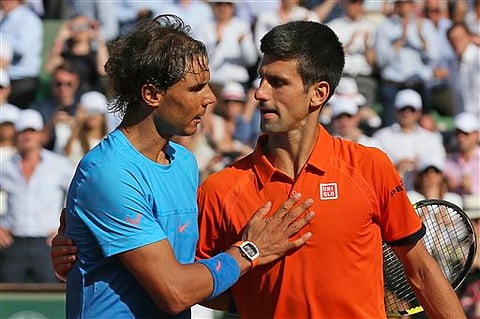

PARIS: At 5-7, 3-6, 1-5 at 0-15 down, Rafael Nadal picked up the ball off a bad bounce, shanked a forehand, his eyes following the ball trajectory at it rose high, higher. Nadal, red from the sun and exhaustion, was willing it to land inside the white lines of the court. But it fell well out. The clay at Roland Garros had changed. It wasn't his ally, a slave to his commands anymore.
Two points later, 0-40 down, Nadal put the second serve out. A double fault. After ten years of building, that's how his kingdom fell.
Nadal was beaten. Novak Djokovic, the world No 1, had achieved the near impossible, defeating the most successful player at any one Grand Slam in less than two hours and in the end, with relative ease.
"No, is not a big surprise," said Nadal of his defeat. But refused to admit that this was the end.
"I'm going to come back next year and I going try to be competitive, to try to be better prepared than this year, and try to arrive with a little bit more good confidence. But, yeah, I don't like to talk about dynasty or these kind of things."
On his 29th birthday, Rafael Nadal had stepped on to the court, his court, like a man knowing that he is walking to his death. The tide had turned too emphatically against him. After Wimbledon last year he had picked up a wrist injury, spent too much time off court, spent not enough time winning matches on clay. In the meanwhile, Djokovic had match by match built his confidence, his validity as a contender for this year's French Open title. He beat Nadal in Monte Carlo and then again in Rome.
And he finally did it at the French Open on Wednesday.
It was only the quarterfinal of a Grand Slam, but it the most important tennis match in a long, long time now. As the day crept towards match time, the sun rose higher in the sky. Not a good sign for Nadal. He prefers when the cloud cover is heavy and the conditions slower.
Djokovic, sporting the colour of the terre battue, was off to a flying start. 4-0 up before the match could hit half-hour mark. It was an intense, physical fight, as we have come to expect from a Nadal-Djokovic contest, but somehow Djokovic kept finding the winning shot.
That was the only time when Nadal showed a semblance of a fight. The whip was back in his forehand and his ground strokes had a bite. He levelled the set to 4-4, jumped in the air and fist-pumped. The Rafael Nadal of old was back, but not for long. He seemed to have put so much into the opening set, that he had no fight left for the rest. He made 30 unforced errors, already a number too high when you consider that his legacy is built on playing the percentages, and hit only 16 winners.
Djokovic knew he had his man, and didn't waste any time in delivering the judgment.