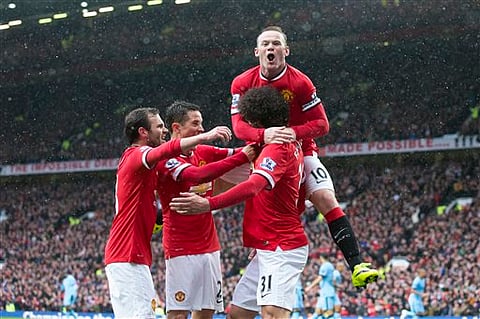

Ray Hall was the manager of Everton's academy for almost a quarter of a century and, if there is one moment he will never forget, it was the first time he saw Wayne Rooney. Everton's Under-Nines were playing against Manchester United.
"Picture the scene," says Hall. "About 150-200 parents on one side of a small field, the coaches of Manchester United and Everton on the other. Eight against eight. The ball comes across about head height and I'm looking at Wayne thinking, 'He'll head this' but he didn't. He turned his back on it and made a bicycle kick. The ball went straight into what was a small-sided goal.
"There was silence. No one had seen that before from an eight-year-old boy. Suddenly somebody started to applaud. After that, everybody clapped and the coach from Manchester United looked down the line as if to say, 'What have we just seen?'"
What they had just seen was a young boy who would continue to make the jaws drop of even the most hardened football coaches and is now poised to break Sir Bobby Charlton's all-time record for England goals. Yet amidst all the applause, should Rooney score the two against San Marino tomorrow night to surpass a landmark that has stood for 45 years, we would also be compelled to reflect. Rooney turns 30 next month; he has played in an era where competition for the England centre-forward position has been limited and when the country's impact in the major international tournaments has been fleeting. Has this really been the fulfilment of an extraordinary talent?
There was a time, after all, when Rooney breaking Charlton's record was not expected to be the crowning moment of his career but a footnote en route to global greatness. Rooney, remember, was reckoned good enough by Walter Smith to play for Everton when he was 15. By 16, Hall regarded him as the best senior player at the club and, after he scored a spectacular first Premier League goal past David Seaman, Arsene Wenger described him as the best English talent he had ever seen. Two years later, Sven-Goran Eriksson was comparing Rooney's impact at Euro 2004 to that of Pele in the 1958 World Cup.
Few at Manchester United back then would have said that Cristiano Ronaldo was the superior 18-year-old. "Rooney was the better all-round player," says Rio Ferdinand. "He was a more mature footballer who could bring the rest of the team into the game and could score and make goals."
Fast forward to their supposed peak years and Ronaldo has scored more than 50 club goals in each of the past five seasons. Lionel Messi has managed more than 40 six years in a row. Rooney has only ever been past 20 three times in his 11 seasons at United, while his international record at the final stages of major tournaments still stands in the shadow of Charlton.
"There is a little way to go when you make comparisons as players," Sir Geoff Hurst says. "If you're making comparisons, Wayne is a front player, whereas Bobby Charlton scored 49 goals as a midfield player. It's not only their ability, it's what they achieved in the game, and of course Bobby Charlton was the member of a World Cup-winning team."
None of this is to deny Rooney's fabulous career, just to acknowledge how our hopes have had to be recalibrated. Perhaps they were always unrealistic - and maybe Rooney is a victim here of simply being an unusually early developer - but listen also to some of those who have worked with or played against him and you do wonder. There is a common theme. It is essentially the suggestion that Ronaldo has looked after his body rather better and lived the life of an elite athlete 24/7. They are observations that could apply to English players beyond Rooney.
"Our players aren't world class," Joey Barton told Radio Five Live last year. "Rooney could have been world class but look at his mentality compared to Cristiano Ronaldo. When you see Wayne Rooney smoking cigarettes, does he live his life correctly? From the questions I've asked of players who have worked with both... he [Ronaldo] is in the gym or honing his game."
Dietmar Hamann agrees. "Rooney always knocked on the door to be world class but never did the final step and Ronaldo overtook him because he's obsessed."
Sir Alex Ferguson is less direct in his observations but, study his autobiography, and we return to a similar subject. "He [Rooney] has great qualities about him but they could be swallowed up by a lack of fitness," he warned. "Look at the way Ronaldo and [Ryan] Giggs looked after themselves. Wayne needed to grasp the nettle."
Ferguson then described how, in his final year at United, he felt that Rooney seemed to tire in games. Ferguson felt he needed to be playing regularly and intensely to stay at his best; an observation which perhaps explains why the break before summer tournaments seems to blunt his sharpness.
Mick Clegg was Manchester United's conditioning coach for 11 years and has pointed out that, given Rooney's naturally powerful frame, there were legitimate concerns about spending too much time in the gym. He says Rooney was an "amazing athlete" and that Ronaldo was simply a "freak in football" in that 99.99 per cent of players spent less time in the gym.
Other supporters of Rooney also argue that his outlook has always been much more team-orientated than Ronaldo's. It is certainly impossible to be around England and not sense Rooney's popularity inside the dressing-room and his obvious intelligence and humour.
Sid Benson, a former Everton scout who has known Rooney since the age of eight, is adamant that he is among the very best in the world. "He is unselfish," says Benson. "If you went up to Messi and said, 'listen, I want you to play right-back tomorrow', he would tell you where to go. If you said to Ronaldo, 'centre-midfield, I need you to do a job', he would be, 'no, no, no'. If you said to Wayne, 'we're struggling, we need you in goal', he would say, 'where are the gloves?'. That side of him doesn't get recognised. He's right up with Ronaldo or Messi and any British footballer I have ever seen."
Now is certainly a time for English football to celebrate Wayne Rooney but it is also a good moment to ask how we inspire even more from the next prodigy.