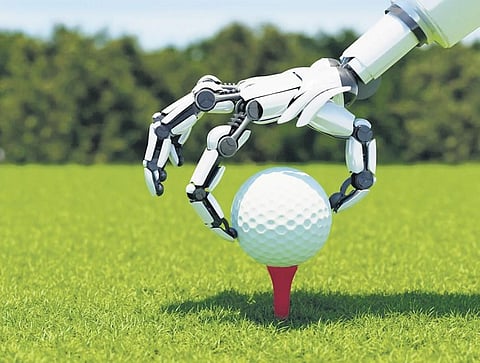

To play is to be human. To err is human too, but technology levels all playing fields, and gets decisions right. Gone are the days when the umpire or referee was the last word. Now there are DRS (Decision Review System), Hawk-Eye and the Video Assistant Referee, which follow the trajectories of balls in cricket, tennis and football respectively, to give accurate results, reducing erroneous decisions to near extinction.
What once seemed unimaginable has now become conspicuous. For instance, the DRS that was officially launched by the International Cricket Council in November 2009 during the first Test between New Zealand and Pakistan, helps umpires ascertain if the ball was pitching in line or outside, hitting or missing the pads, bat or the stumps. Hawk-Eye technology, which uses multiple cameras to track the position of the ball, and allows players to challenge point-ending line calls, officially became part of international tennis in 2006, first at the Nasdaq-100 Open in Key Biscayne, Florida, and then at the US Open the same year. Like everything else, tech in sports is only expected to get better all the way through to a revolution.
Play Smart
Equipment across sports, including cricket, football, tennis and golf is expected to go smart. While technology-enhanced viewing systems can increase the accuracy of human judgement, the advent of smart balls will give them a voice of their own. Cricket ball manufacturer Kookaburra has teamed up with tech innovators SportCor to create the world’s first smart ball. Embedded with a micro-chip, the ball will be able to collect real-time data based on its movement.

“It feels and moves the same way as a regular cricket ball, but collects and communicates instant statistical data on revolutions, speed—both at release, pre-bounce and post-bounce—from the embedded microlight chip,” states the Kookabura website. A similar microchip technology is expected to find its way into golf, which is believed to help players “locate an erroneous shot”. With the chip being GPS enabled, it will also help spot lost golf balls. Golf clubs too can be expected to get a smart upgrade, with four clubs —a driver, an iron, a wedge and a putter—replacing the traditional 14. The heights of each of the four clubs can be adjusted by several inches to serve the required purpose, and “the head will adjust to the loft you need”, The Professional Golfers’ Association of America has predicted.
Also expect players’ apparels and footwear to get sensor-integrated, allowing them and their coaches to receive real-time figures to help “improve biomechanics and optimise training”. This will help sportspeople to better their form, technique and timing. Smart sneakers boasting a gyroscope, accelerometer and pressure sensors will help athletes curate accurate training routines to not just enhance performance but also avoid injuries.
Eye of the AI
Historically, coaches have watched hours of footage of the opposing team to zero in on the best defence and offence strategies in football. Give it another few years and AI may be able to come up with a plan of action in a jiffy. As we know by now, AI relies on machine learning, and it can be expected to use the same model to come up with multiple outcomes of a single match played using specific moves. In each case, AI will use its algorithms to determine the strengths and weaknesses of the opponent, making it easier for a player to exploit loopholes and understand which shot works best.
AI can also help prolong a footballer’s career. “The next wave—ushered in by AI—might produce football maestros who can dominate the grand stages into their 40s, blurring the lines between youth and experience,” Leimester Corporation, a sports-focused data analytics company has predicted, adding, “AI assesses variables such as metabolic rate, muscle composition and biomechanics, crafting regimens that maximise output while minimising wear and tear.”
Look and Learn
It is not novel to review your own video recordings to enhance one’s performance in sports. Coaches have been doing that for a while. With holographic technology, sports training may get an unprecedented upgrade, with players being able to follow their own holograms in action to better observe their shortcomings. “In the future, professionals will be able to take that video and create a 3D holographic model of their swing. The teacher can change things such as plane, hand position and weight distribution to show exactly what an improved swing should look like,” says The Professional Golfers’ Association of America. The other visual technology that can be expected to permeate the world of sports in the future is virtual reality, which can come in handy while creating simulated environments for athletes in different sports to practice.