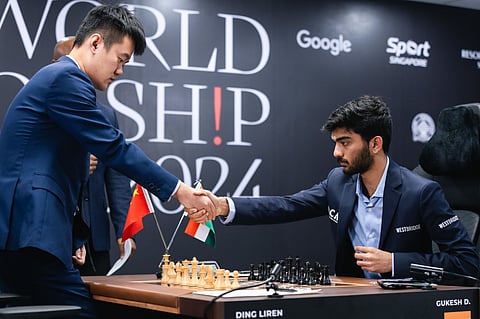

SINGAPORE: Over the last week or so, journalists have come under fire because of the nature of some questions asked to the players during the post-game press conferences. It led to Hikaru Nakamura, one of the biggest chess streamers in terms of content creation as well as following, putting out separate reviews for press conferences (it has brought him a fair number of clicks).
To be fair, some of the questions have been random. One question was whether the players would be interested in visiting some of Sentosa Island's landmarks together (they replied in the negative). Ding Liren has predictably been asked about the Ding chillin' meme (to which he very cutely asked 'what's the meaning of chill?')
With journalists taking the hits on social media, the head of the Local Organising Committee (LOC), Kevin Goh, had to put out a statement defending the nature of the questions. "I can understand if some of the questions at the press conference might seem unusual but the reaction and abuse that the journalists are getting are way over the top," the GM posted on X (formerly Twitter). "There is generally a thought process behind the questions. Not everyone gets it, but if everyone asks technical stuff, the whole press conference will be tense and dry and there's only so much that the players can say about one game."
Goh, also the CEO of the Singapore Chess Federation, is right in his assessment. These questions have helped the players loosen up a fair bit. It may be unconnected to chess but they are needed to flesh out the personality of the two players. And they have generally tended to be light-hearted and entertaining.
Because both players stuck to the book for the vast majority of the 10th game, the most entertaining moment of Saturday came a good 20 minutes after the players had agreed to a draw by three-fold repetition. D Gukesh, like in the previous nine games, travelled to the press conference with his father, Dr Rajinikanth. So the question was if the teen asked his father about some of the moves as the latter has access to technology and 'he's the first chess player you talk to (from your camp) after leaving the playing hall?'
To which the 18-year-old, in a very matter-of-fact way, responded: "He would be happy to hear that he's a chess player." It brought the roof down, a much-needed moment of humour after an uneventful fifth game with White for Liren, the world champion.
Once the laughs ended, they were quickly replaced with stoic expressions on the faces of both the challenger and the champion.
The margin for an error -- forget serious, even an inaccuracy -- has more or less dwindled with just four Classical games to go. With both players tied at 5-5, it feels more and more likely that the player who wins next will have the last laugh. It's no longer a 14-game final. Both camps, when they wake up on Sunday, will see it as a four-game shoot-off and, potentially, tie-breaks.
The tie-breaks
Tie-breaks, then, feel like a good starting point to take stock of the final.
They may be four games away but on the chess24 commentary, both Anish Giri and Peter Leko were talking about it. "I think deep inside, Gukesh has an opinion on whether he wants tie-breaks or not," Giri said.
Gukesh himself remained non-committal on the aspect of tie-breaks when he was asked about it a few games ago. But there is a feeling that the Indian would like to prevent the match from going into tie-breaks.
Why? Because it has faster time controls. The first batch of tie-breaks will see each player having 15 minutes per game with an increment of 10 seconds from the first move. The Chinese has a clear advantage when it comes to games in the Rapid format (his rating is 2776 as compared to Gukesh's 2654). If the four-game Rapid match tie-break is also tied and a further two-game mini Rapid match is also tied, they go into Blitz mode, an even quicker time control. Liren holds the edge in this as well (2785 as opposed to 2615).
These ratings, though, have a significant caveat. The 18-year-old doesn't play them all that often. But because he is more of a calculator than somebody who plays with intuition (a Magnus Carlsen, for example), he may target his two White games to get a decisive result.
Gukesh's two White games
With Liren playing very solid but unspectacular, safety-first chess, Gukesh may have to force it in these two games. The two decisive results have come when he has had White. He has pushed the envelope out with his Openings, there have been some novelty moves made and they have made Liren spend a lot of time. Sometimes, players could have a very interesting idea but they would like to reserve it for the crunch moment. Sunday feels like that moment. It could be the time for Gukesh to play his card. Equally, it's important that he doesn't overreach.
The Veselin Topalov-Viswanathan Anand 2010 match is a reminder of the consequences of pushing too hard with White in the hope of avoiding tie-breaks. Topalov, playing with White, played a reckless game because, at that point, Anand was the world's best in the Rapid format. But Anand picked him off with the Black and the match didn't even go to tie-breaks.
The Openings
It was instructive to listen to Giri on Saturday. "He doesn't take any risks," the Dutch GM said of Liren's overall match play. "He's telling Gukesh 'if you want to take risks, go for it and try and get me. But if I can play safely, I will play safely'. It's why Gukesh's White games have seen more knife fights between opposing pieces. It's also why the Chinese 32-year-old, who incidentally became world champion after beating Ian Nepomniatchchi on tie-breaks, tends to burn a lot of time in the Opening. He wants a solid pawn structure, he ensures he has calculated all lines and wants to maintain balance at all times. It's also why Gukesh's openings with White have seen some interesting ideas come to life.
All three results possible
With just four games to go, all three results are still in play (Gukesh win before tie-breaks, Ding win before tie-breaks or tie-breaks). The attitude of most elite players in such a situation would be to play the positions and not go in with preconceived notions. Liren is the sort of player who will look to kill the oxygen out of any game and go safe. Even though Gukesh has shut down a couple of games from exploding, he likes to go for wins.
Chess fans couldn't have asked for a better ending to this World Championship
Remaining matches
December 8 -- Game 11 (Gukesh with White)
Dec 9 -- Game 12 (Liren with White)
Dec 10 -- Rest day
Dec 11 -- Game 13 (Gukesh with White)
Dec 12 -- Game 14 (Liren with White)
Dec 13 -- Tie-breaks, if necessary (match will be decided irrespective of how long it takes)