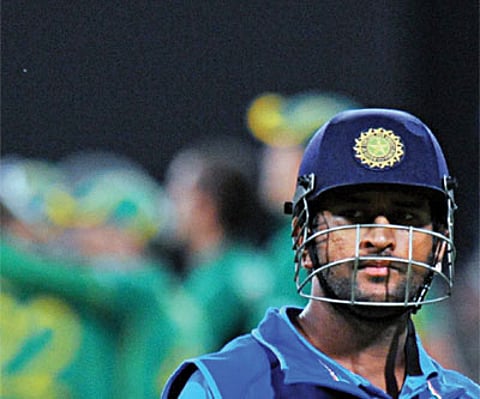

Much has changed in Indian cricket over the past decade. The Men in Blue aren’t mere passengers on tours. They don’t depend entirely on individual sparks for success. They brazenly trade tit for tat in verbal warfare. And they have scrapped the fixation with the game’s aesthetics. The ‘New India’, a widely-circulated image since Sourav Ganguly’s time as captain, is shining, so to say. Given this backdrop, Mahendra Singh Dhoni & Co embark on a World Cup-winning mission with the ‘contender’ sticker firmly tagged to their jerseys. And justifiably so.
India, under Dhoni, have racked up series wins at home and abroad. Ever since Dhoni took over the reins from Rahul Dravid, who oversaw India’s 2007 World Cup humiliation in the Caribbean, India has churned out performances that justify the side being labelled one of the favourites to lift the most prestigious trophy in ODI cricket. Stats definitely back Dhoni. Under his captaincy, India has won 55% of its ODI matches; lost only three bi-lateral series while winning nine; and, on many occasions without frontline players, has buckled three trophies.
The team has won in New Zealand, Australia, West Indies and Sri Lanka, while continuing to be impressive at home, having won 23 and lost only 12 of their last 37 matches.
Pressure demon
All this notwithstanding, a few clichés cling on for some things — like Team India’s first-match blues and final jinx — have not changed.
Losing the first match of a bilateral series or tournament has almost become a ritual; the team has lost the opening match 10 times in 15 series/tournaments. However, in most instances, they have recovered commendably.
Moreover, while the team has increasingly shown the ability to snatch matches from the jaws of defeat, a welcome change from the opposite trend that cricket-followers had grown accustomed to in the 2000s, and fights till the very end, the tendency to lose series-deciding matches and tournament finals still lingers.
Under Dhoni, the team has lost three of six finals in triangular tournaments. Two of the final wins, however, have been largely due to Sachin Tendulkar, who scored a century and 90-plus to orchestrate the CB Series triumph against Australia, and creamed a ton against Sri Lanka to facilitate India’s Compaq Cup victory. At the same time, the Asia Cup victory was accomplished through better team-effort. Digging into lost finals — the 2008 Asia Cup and tri-series in Sri Lanka and Bangladesh — offers little solace for India had dominated these series only to fumble in the final (twice by huge margins: by 74 runs in Sri Lanka and by 100 runs in the Asia Cup), incidentally, against Sri Lanka on all three occasions.
With regard to ICC events, the less said the better. The 2007 World T20 win and the 2003 World Cup final appearance remain the only significant returns after the Men in Blue shared the Champions Trophy with Sri Lanka in 2002. On three occasions (2004, 06 and 09), India bowed out in the group stage of the Champions Trophy while losses to Bangladesh and Sri Lanka hastened the team’s exit in the previous World Cup. Other reasons — from major players suffering injury to fluctuations in form — exist, but the Men in Blue have stuttered under pressure in showpiece events.
Former skipper and national selector Dilip Vengsarkar counters: “You can’t generalise that the players can’t handle pressure. They wouldn’t have won so many matches if they didn’t have that ability. It’s true that they have lost crucial matches, but it’s not as if they are incapable of handling pressure. Few teams in recent history have won as many close games as India. In that case, South Africa are the biggest chokers, as they haven’t won anything of note except the Champions Trophy.”
And yet, the Indian team’s track record indicates that it is found wanting in crucial encounters.
Latest reminder
While the Indian players have undoubtedly shown the ability to soak pressure, they have allowed pandemonium to prevail just as frequently.
The most recent reminder of this malady is of course the South Africa series. After a characteristically patchy start in the ODIs, the players oozed composure while winning the second and third matches of the series from wobbly circumstances. But, yet again, when it came to the series-deciding fifth ODI, the final hoodoo set in. The bowlers, who had been quite effective till then, were largely unimaginative. Fielding and catching, which had shown improvement, plummeted at crucial junctures. And the top and middle-order continued to blunder, playing one shot too many, as they had done throughout the series.
Tactically, Dhoni’s decision to push himself up the order and pursue an aggressive approach didn’t click this time.
Deprived of the services of Sachin Tendulkar, Virender Sehwag and Gautam Gambhir, the Indian batsmen failed to show either poise or purpose. Their numbers on the ODI scoreboard in South Africa — 95-5, 169-5, 93-5, 123-5 and 60-5 — is a harsh pointer to this fact. Apart from Virat Kohli and Yusuf Pathan, the batsmen failed to deal with pressure situations. Suresh Raina was limited to flashy brilliance, Yuvraj Singh is yet to rekindle his match-winning touch, Dhoni wa apparently either too aggressive or too cautious, and Murali Vijay’s focus has seemingly tapered off. It would be foolish to make too much of the 5-0 whitewash of New Zealand. In short, this is not the ideal build-up for the World Cup. There would be no better way for the Men in Blue to ease their nerves than by drubbing Bangladesh in their first match of the World Cup at Mirpur. At the same time, if this team is to live up to its billing, attention must be paid to the following factors…
sports@expressbuzz.com
Calming presence in the middle-order
Of course, going into the mega event, the batting line-up will be bolstered by the return of Tendulkar, Sehwag and Gambhir. While the top order will be packed with substance, Raina, Kohli and Yuvraj are expected to do a good job in the middle order in home conditions. And Dhoni can be the calming influence the side so desperately requires, more so in steep run-chases. The captain’s will be a central midfielder’s role. Dhoni’s ability to modulate his run-scoring pace and his tranquillity under duress add value to the side. His role should be similar to that played by Rahul Dravid in the 2003 World Cup team, analyses former Test cricketer Lalchand Rajput. “Though Tendulkar was the highest run-scorer in that tournament, Dravid’s contributions were equally vital. He lent considerable stability to the team and though he is generally considered orthodox and slow for the shorter versions of the game, he scored at a run-a-ball rate in the World Cup, anchoring the team’s flourish in the slog overs. If Dhoni assumes such a role, which he has on a number of occasions, the team’s batting will obviously look stronger,” says Rajput.
Sustained pressure by bowlers
In the recently concluded ODI series, the Indian bowlers let the South Africans off the hook quite often. Apart from the one-run heist at the Wanderers, the bowlers let slip opportunities to close out the Proteas. At Durban, South Africa was allowed to recover from 82 for 3 and post 286 on the scoreboard. At Cape Town, Graeme Smith’s men were 90 for 4 before nudging away to 220. At Port Elizabeth, they were reeling at 118 for five but managed to force their way to an imposing 265. And in the decisive fifth ODI at Centurion, it was way too late when the Indian bowlers struck.
Harbhajan Singh, though stingy, snared only four wickets while Ashish Nehra (three wickets at 58 and an economy rate of 6.69) and Piyush Chawla (wicketless) failed to impact. But on spin-conducive home conditions, Harbhajan and Chawla, would have larger roles to play.
Unlike Anil Kumble, who spearheaded the spin attack with pride and responsibility, temperament-wise, little has changed for Harbhajan Singh over the course of 217 ODIs. “Kumble appeared mature right from his first match. Harbhajan is emotional and sometimes gets carried away by situations. But as he has proved, he is a match-winner in home conditions,” remarks former player Mohinder Amarnath. Another area of concern lies in the limited international experience of Piyush Chawla and R Ashwin; both these spinners could be targeted by frontline batsmen in the World Cup. “Ashwin has been impressive. He was economical in the powerplays and death overs against New Zealand, but there will obviously be better players of spin than the Kiwis in the World Cup, and they would try to unsettle him early in his spell. Chawla has much to prove. How these two bowlers deal with pressure will be crucial,” says Rajput.
More athleticism, consistency in fielding
While India’s general fielding has improved by leaps and bounds, the players are still vulnerable to lapses and, in South Africa, fielding errors did prove costly. For instance, at Centurion, Ashwin miffed a straightforward chance off Hashim Amla (then on 70), who went on to score a century — this innings proved to be the difference in the end. Even normally reliable fielders like Yuvraj and Kohli can develop butter fingers when hit by pressure — and there will be plenty of pressure during the World Cup. “We are by no means a spectacular fielding side. We are at best a safe fielding side. So, it is all the more important that we don’t spill catches or miss run-outs,” observes Rajput.
