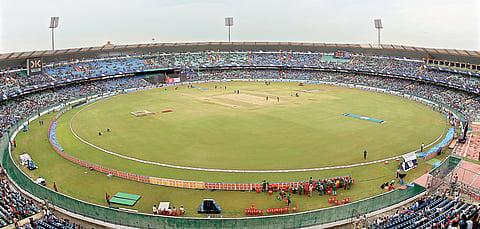

RAIPUR: On November 1, 2000, Chhattisgarh was born, carved out of Madhya Pradesh. Fifteen days later, was formed Jharkhand, splintered from Bihar. The former generates 40 per cent of the country’s mineral resources. The latter supplies 15 per cent of India’s steel. There are other similarities — industrial states with an overwhelming tribal population, both flaring with ideologues of the extreme left.
Their cricketing fortunes have been contrasting. After Bihar’s division, the BCCI recognised Jharkhand as full member while Bihar Cricket Association (not rival faction Cricket Association of Bihar) was given associate status. Conversely, Madhya Pradesh Cricket Association retained full-member status while Chhattisgarh State Cricket Sangh was drafted into the BCCI fold as associate member in 2008 as a Ranchi-born became full-time India skipper across formats.

In January 2013, Ranchi hosted its first international in the state-of-the-art JSCA Stadium. Five months later, the equally high-class Shaheed Veer Narayan Singh International Stadium hosted its first IPL match. In between, another stadium of such-like infrastructure, in as geographically diverse a terrain as it could get, debuted internationally — the Himachal Pradesh Cricket Association Stadium, overlooking the Dhauladhar ranges, in Dharamsala.
The thread connecting the stadiums is evident — Indian cricket branching out to hitherto cricketing outposts. Three vital lumps in India’s political map, but until recently inconspicuous dots on the cricket map. Three states from medium, as in Jharkhand’s case, to little, as with Chhattisgarh and Himachal, legacy in terms of cricketing pedigree.
Maybe, the need for plush stadiums began with the post-liberalisation winds, ushering in the growing up with the Joneses mentality. It became fashionable then, and now a prerequisite, to project the state’s sporting infrastructure, which is most valid in Chhattisgarh’s case. Maybe, it began with Mahendra Singh Dhoni, who ignited the imagination of small-town cricketers. “He played a big role in firing up the aspiration of cricketers from tier-two cities. He opened up avenues and threw open possibilities. Suddenly, there was a boom in cricketers from smaller cities across the country. You ask them all, their role model is Dhoni,” pointed out former batsman Pravin Amre.
Soon, Meerut, Rajkot, Ikhar, Ghaziabad, Bijbehara and Rae Bareli became part of Indian cricket’s folklore as well as fabric. And there is something intrinsically endearing about their narratives. “They are so different to the ones from the city. The boys from the city speak about cars, bikes and sun-glasses in the dressing room. Boys from small towns keep on talking about the game. Maybe, they have limited opportunities, so the moment they see a senior cricketer, they keep asking for advice,” observed former cricketer Lalchand Rajput.
Himachal Pradesh, meanwhile, is blessed with an ambitious politician-cricket administrator, Anurag Thakur, who has ensured the state got its share of international cricket. Chhattisgarh has the backing of an ambitious ministry, who provided sufficient resources for constructing a world-class stadium, chiefly with the conviction it would enhance the state’s sporting profile and partly, in the hope that BCCI will bless them with full-member status.
Road Ahead
Constructing stadiums and infrastructure is just a step in ensuring cricket culture. These states will want their teams to perform in the domestic circuit, and churn out international stars.
Their immediate needs, though, are varied. If Chhattisgarh is waiting for their baby steps in domestic cricket, Himachal Pradesh and Jharkhand are waiting for giant strides. Chhattisgarh desperately longs for the BCCI’s full-member status. Apart from the `20 crore grant full members get, as opposed to `75 lakh the associates, it gives their players an opportunity to grow. “We’ve been doing well in U-19 and other age-group tournaments. But once they are no longer eligible for age-group cricket, they go elsewhere or stop cricket altogether. It’s like after 12th, you don’t have a college to go. Naturally, they seek outstation colleges or stop academics completely. That’s happening with our cricket. Many go out and play for other states,” said Rajesh Dev, secretary of CSCS.
An example is all-rounder Harpreet Singh, a former U-19 India player who switched to Madhya Pradesh in 2009. “We’ve been losing players. These are the fortunate ones. There were many who stopped playing. But we’re hopeful of full-member status, as we have served five years as associate and done well in age-group cricket. Our case is on the table, and hopefully we’ll get it before this Ranji season,” he said.
For all the Dhoni-sparked drumfire, Jharkhand has produced just another international cricketer, speedster Varun Aaron. For a while, Saurabh Tiwary, seemed to be their next whiz-kid, and even played a couple of ODIs only to taper off. Left-arm spinner Shahbaz Nadeem was another, but apart from them the state’s resources seem negligible.
Himachal are restless to unearth a talent worth national attention. All-rounder Rishi Dhawan and wicketkeeper Ankush Bains signify promise. “Dhawan has done well with bat and ball. He was the leading wicket-taker in Ranji Trophy the year before. He averages 40 with bat and under 25 with the ball. With India in search of a bowling all-rounder, he could get a chance. Ankush is a talented ’keeper. There are other talented youngsters in our team. If they make it to the national team, it will be great fillip for the state,” said veteran Paras Dogra.
As Ranchi demonstrates, superior sporting infrastructure is just a means and not an end to sporting perpetuity. The birth of a star is the real tour de force in their sporting narrative. Until then, for all the sparkling stadia, Dharamsala and Raipur would remain outposts, feel-good stories to be briefly paused over.