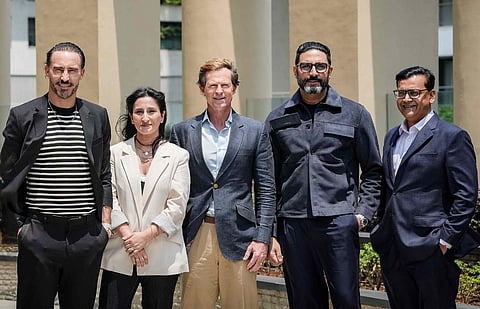

CHENNAI: Jonty Rhodes, Faf du Plessis and Heinrich Klaasen are the latest to join the European T20 Premier League (ETPL), Europe's first ICC-sanctioned T20 league, as owners. The trio have formed a consortium to acquire the franchise based in Rotterdam, Netherlands. The inaugural season set to happen from August 26 to September 20, 2026.
The tournament, with teams based out of Glasgow, Amsterdam, Edinburgh, Dublin, Belfast, and Rotterdam, will see 33 T20 matches played across four weeks. While the league will still be finding its feet, especially in the inaugural edition, one of the challenges and priorities of the franchise and the tournament would be to bring people to the ground — something leagues such as the IPL, The Hundred, Big Bash League, and SA20 have done successfully.
Unlike those leagues and countries, Republic of Ireland, Scotland and Netherlands are not powerful cricketing nations. And the franchise owners are very much aware of that. Du Plessis, one of the co-owners and captains of the Rotterdam-based franchise, admitted as much. “I think the league and all the different teams will have a responsibility in making sure we help to grow the game in the country. I don't want to speak on something I don't know. So just as an outsider, there's potential there, but there's not massive interest in terms of the whole of the public support. So I can relate to leagues like in the American League that I've played in, where you go to a new country where cricket is not the first sport. In fact, it's very low on the ranking system,” the South African explained during a select media interaction on Thursday.
“What happens over time is you do grow your team, you do grow people talking about the game. So eventually, year by year, you see a new audience, you see new fans, you see new people coming to the game. The responsibility in the league and on all the teams is to make sure that they can grow the pipeline, they can implement a pathway systems to make sure that it's not just a three weeks or four weeks of the year, and then it's out. But then the rest of the year, what happens? How can you grow the love for cricket within Europe?
“So there are a lot of stakeholders. We are included in that to make sure that we can do a little bit more than just come in and out of a tournament. Because I think the growth of the tournament will be slow, then you really have to make sure it's a team product, you invest well in the product. If you do that, people will then come and see what's all the fuss about? Why is there music playing at the stadium? Let me go and check some of the superstars playing. Let me take my family, my kids. And eventually you grow the whole package. So it is something that's unique. It's not a cricket first loving system. But there is great opportunity there,” Du Plessis added.
Rhodes felt that the pride of representing the country and the inclusion at the Olympics will help the drive amongst people to take sports from recreational to professional. He believes that the sport being recreational in culture will help as well. “I think having played in Sweden, what was interesting is that on the men's side, it was mainly Southeast Asia or diaspora. Whereas with the women, we really started attracting the female Swedish players who were ice hockey players, tennis players, athletes, CrossFit athletes. Because there's a real pride in representing your country and in Europe. Now, cricket is a part of the Olympic Games. You have a huge opportunity to incentivise or introduce another sport,” Rhodes explained.
“You can attest to the same in South Africa. We grew up playing different sports. I played tennis, I played hockey, and I played football. And all three of those combined to make me a fielder. Because I didn't have a fielding coach. So you have got a country where golf, tennis, hockey and football are already a part. And Europeans are active people. I know in India, we watch a lot of sport. And slowly, people are starting to participate. The understanding that activity is essential for kids, for families, for our own health and wellness. But in Europe, it's already a pastime. So if we can have the music on, have people coming down and are inquisitive and give them fun things to do. That's not a technical cricket challenge. You can almost be a hockey player or tennis player or football player. And you can do well at cricket if you don't introduce too early on the technical side and get the kids loving being involved. I think that for me, having seen that in Sweden, and understanding the national pride in Europe, where being a part of the Olympic Games is a massive goal for a lot of the young kids in Europe. So, you know, we can drag other sports in and then convert into cricket through watching and enjoying the game,” he added.
