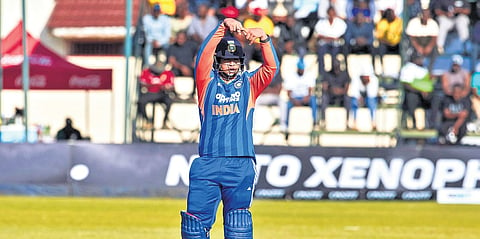

Fifteen-year-old Vaibhav Sooryavanshi produced a composed 81 off 48 balls to guide India to a competitive 192/5 against Zimbabwe in the third and final T20I at the Harare Sports Club on Sunday, anchoring the innings with two crucial partnerships after the visitors opted to bat first.
Opting to bat first, India encountered a slightly tacky pitch at the Harare Sports Club, and Sooryavanshi showcased another side of his batting during his 48-ball innings.
The 15-year-old started in a relatively subdued fashion - first 10 balls produced a mere 11 runs, the next 10 saw the arrival of 15 runs, and eventually his second T20I fifty came in 31 balls.
There were a few stunning shots as one would expect in a Sooryavanshi innings.
A straight punch for a four off Brad Evans' yorker and then a 102-metre six off off-spinner Sikandar Raza showed his age-defying power and skills.
There was a moment of innovation too when he reverse swept spinner Wesley Madhevere for a boundary.
But overall, it was an innings of restraint on the day from the Bihar boy.
But on the other hand, his opening partner Abhishek Sharma got out for his sixth below par score in succession, edging pacer Blessing Muzarabani to stumper Tadi Marumani.
Now, Abhishek's last six innings read: 10, 16, 3, 1, 8, 2, dating back to the third T20I at Nottingham against England last month.
But Sooryavanshi showed enough maturity to stitch a 75-run partnership with Ishan Kishan (29) for the second wicket and followed it up with a 50-run stand with Shreyas Iyer (27) for the next wicket.
However, Sooryavanshi fell close to a well-deserved hundred with Evans taking a stunning catch at long-off off Madhevere.
Once Sooryavanshi and Shreyas departed, the middle order batters struggled to impart the desired momentum to the innings.
It reflected in the 47 runs they scored off in the last five overs, and it required Rinku Singh's cameo (25, 14b) for India to move closer to 200.
But the home side might find it challenging on a track that has something in it for the bowlers.
(With inputs from PTI)
