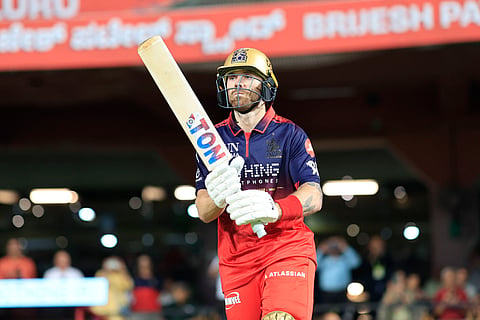

CHENNAI: Earlier this Indian Premier League (IPL) season, Mark Wood, in a podcast, had narrated an unusual incident featuring an owner of one of the sides he was part of. "I wasn't very well after about five games," he had recounted during the BBC's Strategic Timeout podcast. "The next game was in about three days' time. Every half an hour, the doctor would stay back, come to my room, check on my vitals.
"... I remember one day the owner ringing me, 'how are you feeling? Ready to go?'" Wood, who has featured for two IPL teams, was so weak he was condemned to his bed so he said 'I have eaten and drunk nothing. I still can't get out of my bed. The owner, clearly not amused, pushed his luck, according to the pacer. "He said 'We will get you another doctor... I will send you a private plane, you get in the plane, play the game. Then I will get plane straight back out and get you back to your bedside.'"
Wood didn't take up the offer but he thought "that's the coolest thing that's ever probably happened to me in my life".
These days, it increasingly looks like foreign boards do not want to take any chances with an overzealous franchise or two. It's perhaps why at least two cricket boards have taken the decision to fly their players out back to their own countries for scans or and/or giving them the green signal for them to bowl competitively.
Earlier this month, Phil Salt was flown back to England by his parent board after he had sustained an injury on his finger. Is it because of some unwritten protocol that the England and Wales Cricket Board (ECB) have with their players? Even if it's some new guideline not in the public domain, this appears to be a recent pattern because Ben Stokes was allowed to do his rehab at the Chennai Super Kings a few seasons ago.
Meanwhile, Jamie Overton, who is understood to have first picked up an injury during the game against Delhi Capitals on May 5 and underwent scans in India, played against Lucknow Super Giants on May 10. Having been ruled out now, he is now enroute to UK to have another scan to understand the extend of his injury before deciding on further course of action. So did his injury potentially aggravate in the second game? An ECB spokesperson has been approached for comment on whether there's a protocol in place.
At this point in time, this trend has predominantly featured cricketers from England and Australia. Sunrisers Hyderabad skipper Pat Cummins went back to Australia at least once after the start of the tournament for scans and to receive the final fit to play clearance from the board (the Mitchell Starc case is different as he didn't land in India till he was given the go ahead).
Lack of trust in India's sports medicine facilities?
When an industry expert was asked about this seemingly new trend, the person opined that this could be because of a protocol with their own cricket board. The person also suggested that the players may have their own physios and facilities they could trust more than existing Indian sports medicine facilities. While India's sports medicine facilities have improved an awful lot over the last decade, one needs to keep in mind that Indian cricketers themselves opt to have surgeries or consultations elsewhere. It suggests that while India may be the 'pharmacy of the world' in the eyes of many, for elite cricketers, that may not be the case.
There's also the scenario surrounding Cooper Connolly, another CA-contracted player (none of this is to suggest what CA is doing is wrong; they are entitled to protect their players' well-being in the way they best deem fit). When there was a small window in April, he had travelled back to Australia for scans on his back (he's yet to bowl in this IPL). Josh Hazlewood, whose own comeback from injury has been managed and monitored very carefully, completed the final leg of his return to competitive action in India after landing in Bengaluru a day or so before the opener.
Is this a one-off or is the beginning of a sequence? Only time will tell.
