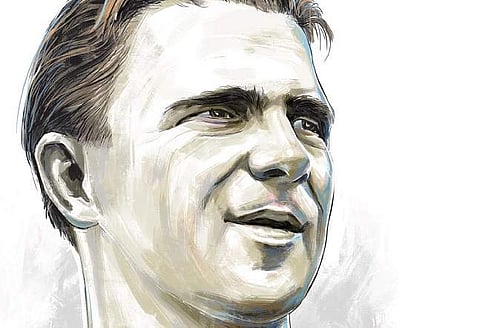

Football was the last totem of a steadily decaying British empire and they wanted to hold on to their so-called dominance for a little longer. So, as the story goes, they invited the Hungarian national team — the newly crowned Olympic champions — for a friendly at Wembley in 1953. What better way than to remind the world that they, the English, were still the top dogs than by beating the team that hadn't lost anywhere in three years? Right? Wrong.
The Aranycsapat, one of the greatest sporting secrets of the Iron Curtain, came to England and demolished the hosts 6-3 at Wembley, the spiritual home of the sport. While England still relied on tried and tested pre-War tactics, the Golden Squad, led by Ferenc Puskas, created complex geometry all over the field. Nandor Hidegkuti, for example, was deployed as a false nine 60 years before it became mainstream. At the return fixture in Budapest in 1954, the hosts went one better. Six-three became seven-one as Puskas, who scored four of the 13 goals, and Co put forth their credentials as the newest Gods of the Beautiful Game.
It was in this backdrop that Hungary went into the 1954 World Cup. They were favourites and behaved like one till the final as West Germany, who were beaten 3-8 by the Magical Magyars in the group stages, performed the mother of all miracles to triumph 3-2 in the final. That loss acted as the beginning of the end of a glorious international career. It also acted as the trigger for the 1956 uprising in the country as masses rebelled against Rakosi's leadership.
What elevated the Galloping Major — players were given a military rank after Honved (the club Puskas used to play) was taken over by authorities — was his unflinching, honest views of the Communist regime. He supported the rebellion and decided to stay back in Spain after travelling there for a European game with Honved. An athlete under the purview of Communism had spoken out against the government, unheard of in those times. His Hungary career, after a barely believable 84 strikes in 85 matches, was truly over but he had an even better second innings at Real Madrid, where he won five La Ligas, three European Cups and scored 242 times in 262 matches.
Lots of anecdotes capture Puskas' sheer insouciance with a ball at his feet but one story has stood the test of time. This incident, at a coaching camp in Australia when Puskas had long retired, was narrated quite brilliantly by George Best in his autobiography 'Scoring at Half-Time'. "I was with Bobby Charlton, Denis Law and Puskas..." he wrote. "The youngsters we were coaching did not respect Puskas, making fun of his weight and age, so he decided to try and hit the crossbar ten times in a row. He stepped up and hit nine in a row. For the tenth shot he scooped the ball in the air, bounced it off both shoulders and his head, then flicked it over with his heel and cannoned the ball off the crossbar on the volley. All the kids stood in silence before one of them asked who he was? I replied: 'to you, his name is Mr Puskas.'"