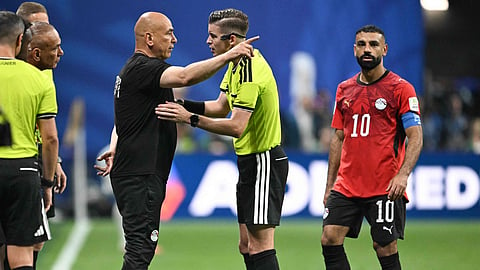

BENGALURU: IT has now been a few days since the raucous Egypt - Argentina Round of 16 tie. However, accusations of collusion and corruption have refused to die down. Here's a look at the two incidents at the centre of the dispute...
58th minute: Goal disallowed by VAR after spotting foul on Lisandro Martinez

The only objective mistake the on-field referee made here was in failing to issue a yellow card to Zico who had removed his shirt to celebrate following a thrilling counter-attack down Egypt's right. Everything else, though, is subjective; open to interpretation and depending on the rules you are familiar with in the different leagues you watch.
There are multiple things you need to keep in mind. The major thing, though, is the football world had been told in no uncertain terms that the refereeing would be light touch and there would be a greater propensity to let things go for the sake of momentum. That has largely been true apart from grappling and contact inside the penalty box during corners (it’s why a Germany goal against Paraguay was ruled out even though it seemed legitimate to the naked eye).
Coming to the actual foul itself, incidents such as these have been allowed to go before at the World Cup (Germany's Leroy Sane scored in a phase of play against Ecuador when one of their players may well have committed a foul for a high boot).
But the VAR has complete remit and agency to wind back to when possession was won by Egypt and to look for any 'clear and obvious' infringements that may have been missed by the on-field referee. In this example, Egypt regained possession after Martinez lost the ball. Ultimately, VAR ruled that he was fouled by Marwan Attia, a light tug off the shirt as well as minor contact on the defender's toe.
In decades past, football's lawmakers and players may have come to view those incidents as 'normal' in a contact sport'. In a world of VAR, those things itself have been redefined. Was it enough for the VAR to intervene by inviting the on-field referee to have a look at the clips again? Only he can answer that, but this hasn't been in line with how these incidents have been refereed in this World Cup so far. There has generally not been a propensity to re-ref movements via the VAR booth.
Also, in some European leagues, they may have judged the beginning of the attacking phase differently. For example, the Premier League may not have wound back over 10 seconds to arrive at this decision but that doesn't mean this is some gotcha moment to claim there's some mass conspiracy.
92nd minute: goal by Enzo Fernandez allowed to stand
Okay, there are multiple things to discuss here. Firstly, this idea that VAR didn't check for infringements. It's routine for VAR to check for any and all potential infringements immediately after game-changing movements (red card, a goal being scored, penalty being awarded etc). Just because the on-field referee wasn't sent to a monitor here doesn't mean the VAR didn't scan for potential fouls. It just meant that they looked at all available footage and decided there was no need to intervene.
In multiple leagues, it's fairly common for commentators to inform viewers that a check is going on in the background. It's also fairly common for them to inform viewers that a check is complete and the VAR found nothing. If they want to examine something in bigger detail, that's when the graphic comes on the screen (check ongoing). This is when play is stopped.
In this instance, the VAR would have seen both those incidents and told the referee that there was no need to stop play. So this idea that VAR didn't even bother checking the incidents in question is rather misleading.
Coming to the incidents themselves, there was one between Mo Salah and Julian Alvarez. After driving into the box, the former Liverpool winger lost the ball to an Alvarez tackle. Then, there's minimal contact on Salah's foot with both players not in control of the ball. VAR will have seen this, but normally, there's a higher threshold to give penalties. The reason is simple.
When VAR thinks there's a clear foul outside the penalty box and flags it (like it did in the Zico case), it doesn't come with a caveat of a penalty. But when it looks for a foul in the box, the threshold is automatically higher because it comes with the added punishment of a penalty.
In Egypt's case, something former referees have also suggested over the last few days, they would have had a higher chance of getting the Argentina goal chalked off if the contact between Salah and Alvarez had happened outside the box. Likewise, the off-the-ball episode between Alexis Mac Allister and Hamdi Fathy. VAR will have seen it but will have decided there’s not enough in there to warrant a penalty.