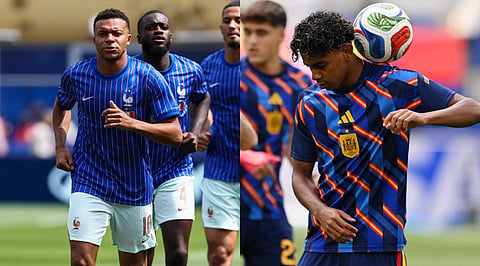

BENGALURU: In last season's Champions League, a total of 128 Spanish players played for different clubs across Europe's biggest football club competition. The second best? England with 103 players.
Even though 99 players born in France have featured for different countries at the World Cup, no other European nation has influenced football in the modern age like Spain. In the years when Pep Guardiola first made Barcelona into an uncompromising winning machine, one theory — juego de posicion — became king. Positional play. The Spanish genius took it everywhere. Barcelona. Bayern Munich. Man City. All these teams won everything as he kept evolving his principles, but positional play was at the heart of everything he did. At City, there was a historic treble.
Over the last few years, this positional play has run into rough weather. Late last year, he had said: “Modern football is not positional. You have to ride the rhythm.” Over the last few years, the sport at the elite level has become slightly more chaotic. More up and down. Direct and more transitional. Teams these days want to attack immediately after gaining possession.
This version of Les Bleus is the sport’s gold standard at it. As soon as they win back possession, they usually target the empty spaces for the likes of Kylian Mbappe and Ousmane Dembele to run into. It’s why their main threat comes during transitions. Spain coach Luis de la Fuente is a coach known for his positional play, but the way he tweaked it was front and centre at the 2024 Euros: adding pace in the wings and stretching the play worked like magic for La Roja.
Spanish midfielder Lamine Yamal broke it down after his team won their quarterfinal against Belgium. “I expect a team that will come after us, but not press us one-on-one all over the field for the entire match,” Yamal said. “I don’t think any national team is going to play us man-to-man across the whole pitch. We all know France has tremendous quality, both in attack and defence. They’re a very physical team. But we’ll play our game. We will try to keep possession of the ball.”
Run through every great European club side over the last decade or so, and you would invariably have a Spanish midfielder or a coach. And Guardiola’s influence has stretched to such an extent that the next generation of coaches commanding attention are Spaniards (Xabi Alonso, Mikel Arteta, Cesc Fabregas and Andoni Iraola). This played itself out in many ways, including on the continental and world stage. For 27 straight finals featuring Spanish clubs or the men’s national team, only they won. This run ended last year.
It is kind of why the first semifinal is basically a clash of styles. Spain hog the ball while France know they are at their destructive best in the first 10 seconds after regaining possession. Take a look at the possession and passing metrics of both sides in their first six matches and this becomes clearer. For Spain, it’s 734 and 74 % (Cape Verde), 668 and 67 % (Saudi Arabia), 553 and 67 % (Uruguay),570 and 64 % (Austria), 467 and 55 % (Portugal) and 598 and 68 % (Belgium). For France, it’s 505 and 53 % (Senegal), 540 and 56 % (Iraq), 480 and 57 % (Norway), 484 and 61 % (Sweden), 510 and 76 % (Paraguay), and 432 and 48 % (Morocco).
The two-time champions make fewer passes and, generally, as a result, have less possession. Tuesday’s encounter at Dallas will generally follow the same pattern. Spain will have more of the ball — curiously enough, both teams will prefer it — and they will also press more aggressively once they lose it. Among the top eight teams at the World Cup, they have recovered the ball in under 12 seconds (by this metric, Didier Deschamps’ side are more laissez-faire) when they lose it. Deschamps’s interpretation of the sport has evolved over the years. In fact, he was fairly rigid when he took over the French team a decade ago. But over the last two years, he has given the keys to his forward line to express themselves without implementing the sort of structure fundamental to juego de posicion. In footballing terms, this is relationism. To implement this style, player chemistry and understanding trump any kind of system one might want to implement. One would argue that this system has been key to getting the best of Mbappe, Dembele and Michael Olise as a trio. Imagine giving Michaelangelo a blank canvas but with caveats.
The first semifinal between France and Spain, then, is really a battle between the football of the streets in the narrow Parisian banlieues and the one crafted at La Masia and the Basque Country.
