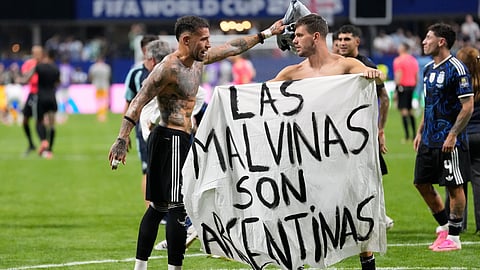

LONDON: The British government on Thursday urged soccer's international governing body to investigate Argentina's team after players posed with a banner claiming sovereignty over the contested Falkland Islands.
Argentina beat England 2-1 in the World Cup semifinal on Wednesday in Atlanta.
During post-match celebrations, Argentine players held a banner handed over by fans in the stands, reading "Las Malvinas son Argentinas" – "The Malvinas are Argentine." Argentina refers to the Falkland Islands as Islas Malvinas.
The team could face disciplinary action from governing body FIFA for violating rules banning political messaging on the field.
UK Business Secretary Peter Kyle said that the players' behavior was "entirely inappropriate."
"Politics needs to be separate from football," Kyle told the BBC. "In fact, the World Cup has one of its central tenets that politics is separate from football.
"That is now a matter for FIFA. I expect FIFA to do its investigation thoroughly."
The sporting rivalry between the two countries is heightened by political tensions over the South Atlantic archipelago, a British overseas territory with a population of around 3,500 people located about 8,000 miles (13,000 kilometres) from the UK and 300 miles (480 kilometers) from Argentina.
Argentina argues that the islands were illegally taken from it in 1833. Britain, which says its territorial claim dates to 1765, sent a warship to the islands in 1833 to expel Argentine forces who had sought to establish sovereignty over the territory.
Argentina invaded the islands in 1982, triggering a 10-week war, won by Britain, that killed 649 Argentine troops, 255 British service personnel and three islanders.
