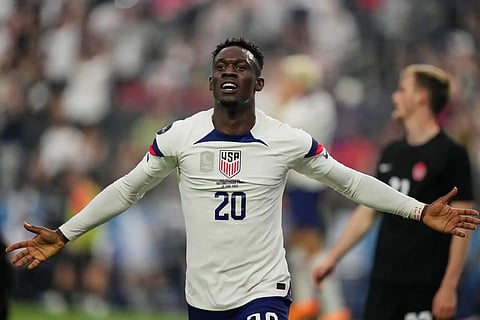

IRVINE, Calif.: Folarin Balogun chose to play for the United States precisely because of the opportunity he’s about to get over the next few weeks.
Balogun could have stuck with England, where he grew up and with which he began his international career at the under-21 level. He also considered playing for his parents’ Nigeria.
But three years ago, the goal-scoring striker chose to represent the country in which he was born — and instead of being stuck behind Harry Kane and Ollie Watkins with the Three Lions, the 24-year-old Balogun is likely to be an important player for the Americans in their home World Cup.
“I feel like my individual journey is a bit full circle now, approaching the World Cup,” Balogun said this week at the US training base in Orange County, California. “Especially with the World Cup being here, the opportunity to represent my nation in front of a home crowd is going to be something special for me, for my family, for my friends and for the team. I’m definitely looking forward to it, and very proud.”
Balogun’s decision was a coup for the US because of his elite skill — he scored 19 goals for Ligue 1’s Monaco this season — but also because he does a job that the American team has historically struggled to fill.
Ever since the US began to achieve regular World Cup qualification nearly four decades ago, one big problem has prevented the Americans from making any additional progress: They can’t win because they don’t score enough.
A nation brimming with world-class athletes across the entire spectrum of sports has struggled to consistently produce soccer scorers, particularly the elite strikers who generate goals, excitement and wins.
The US scored three goals in four matches at the Qatar World Cup four years ago, with just one coming from a striker. It’s a generational issue: In their past eight World Cups since 1990, the Americans have scored a paltry 28 goals in 30 matches.
But the forwards likely to be at the front of the American formation this month are eager to prove they can change things, starting in the US opener against Paraguay on Friday night.
Balogun and fellow striker Ricardo Pepi both have solid credentials in European club play, and they’re entering the World Cup in strong form, with Pepi also coming off a 19-goal season for PSV Eindhoven.
Haji Wright, a Los Angeles native, scored that lone striker’s goal for the US in Qatar — even if he maybe did it accidentally — and he has improved since then, racking up 18 goals last season while Coventry earned promotion to the Premier League.
“We see this as a fantastic opportunity to play in front of our country,” said Pepi, who wears the No. 9 shirt. “The pressure aside, we see it more as an opportunity.”
The US doesn’t have to rely solely on its strikers to score, of course. Forward Christian Pulisic is still likely the most talented offense-minded player in a US shirt despite his recently ended scoring drought, while Weston McKennie regularly contributes offense for club and country.
“I just feel like we’re deeper now,” midfielder Gio Reyna said. “We’ve got a really, really deep squad. I feel like we can be really dangerous in all areas of attack, whether it’s build-up, transition, or having the ball in the opponents’ half. I think we’re more complete now.”
But productive strikers are usually vital to any hopes of sustained success in the sport — and all three of the Americans’ top options are eager to build on their international success.
Pepi has 13 goals in 37 appearances for the US, while Wright has seven goals in 20 appearances, including the only World Cup experience in the group.
“In certain ways, (this World Cup) feels bigger, being here with our family and friends,” Wright said. “It does add a little bit of additional pressure, but I think that’s a good thing. It forces us to perform in ways maybe we didn’t know we were capable of.”
Balogun has scored nine goals in 27 appearances since joining the program — and he even scored a goal against Paraguay last November.
Balogun is the most compelling option in the deck, and he scored during the Americans’ friendly victory over Senegal two weeks ago. US captain and defender Tim Ream says Balogun is probably “the most annoying” American forward to defend in practice.
“He is so quick with his movements,” Ream said. “He’s physically strong and able to seemingly glide past people. He’s able to hold the ball up, bringing other people into play. His movement in behind, being in position and getting himself into goal-scoring position is something that we’ve been crying out for for a long time. He brings that.”
