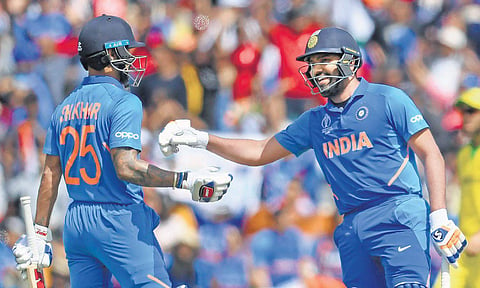

Big totals need robust starts. To get those skyscrapers around 350, teams need to maximise the first 10 overs when there are fielding restrictions. It’s a period when openers try to come hard at the new ball and send it to distant corners of the field. That’s how you play one-day cricket. Right?
Wrong. The Indian approach has been conventional in this World Cup in the initial stages of the innings when batting. Instead of going bang-bang, they have tried to preserve wickets. Batsmen capable of big hitting have looked to get set rather than going over the top. And this philosophy has still got them the results. On Sunday against Australia, they got 352 following this method.
In the first match against South Africa, India’s total after 10 overs was 34/1. There were three fours in it. Against Australia, this was 41/0, with four fours. There was hardly any attempt to clear the fence in that period. It was almost like one-day cricket of 20 years ago. And yet, the eventual total in the second game was in sync with what is the standard these days. In both games, India’s batsmen appeared to be concentrating on not giving away wickets early on, when the best bowlers of the opposition were in operation.

Asked about this after the Australia game, India’s bowling coach Bharathi Arun indicated that the team is following this kind of a plan. “In England the ball moves around a bit in the early stages. You saw that when England played against Bangladesh. They were nine after five overs but ended up with 60 in the power play. If you can assess the conditions, you can launch (attack) later.”
It’s early days in the competition for the Indian team, but at the moment their average run rate of 3.75 after the first 10 overs is the lowest of all 10 teams. It’s possible that dependence on the top three has prompted the formulation of such a strategy, wherein the batsmen lower down the order are given the task of facing fewer deliveries and going after the bowling.
Australia skipper Aaron Finch seems to be of the opinion that this is a conscious ploy followed by the Indian team at the moment. “It felt as though they (Indian openers) swallowed their pride and really pulled back a gear and made sure that they got through the first 10 overs. And when you’ve got world-class players on good wickets and 10 wickets in hand, you can start to up the ante a bit earlier (towards the end of innings). I think not giving away wickets early on was the key.”
It’s not that all the teams that have started well are following this plan. England and New Zealand have average run rates 6.30 and 6.13, respectively, in the first 10 overs. But there are also examples like Sri Lanka (6.50), West Indies (6.25) and Pakistan (5.70), who have started on a brisk note and been unable to sustain the momentum later in the innings.
In a World Cup tipped to witness high-scoring games, the first 10 overs were expected to see a lot of fireworks. With the likes of Chris Gayle, Jason Roy and Martin Guptill around, that can still happen. Amidst all that, the Indian template stands out for being different and effective. It’s a new way of approaching the first power play period.
“If one of our top three gets a hundred, then these guys (those batting lower down the order) become even more dangerous because they have a platform where they can just come in and play like a T20 game. As long as we do the job at the top, these guys will always be a factor for us,” the India skipper’s comments after beating Australia summed it up perfectly. It’s a ‘power ploy’ that is paying dividends and for a change, Virat Kohli is smiling more often than he does.
Dhawan to undergo scans
Shikhar Dhawan will undergo precautionary scans on Tuesday to determine the extent of injury on his swollen left thumb after getting hit against Australia. It has been learnt that physio Patrick Farhart will take a call on his participation in the next game against New Zealand at Trent Bridge on Thursday after precautionary tests .