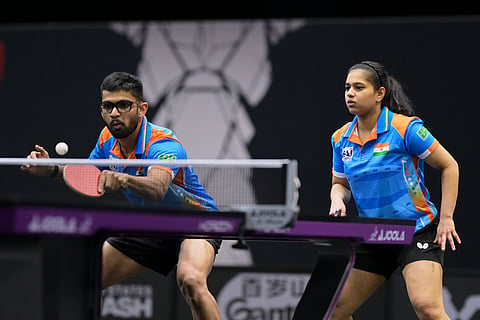

CHENNAI: As the Asian Games in Japan beckon, India will hope for another table tennis medal at the quadrennial bash. After the pair of Sutirtha and Ayhika Mukherjee got the only bronze medal at the previous event in 2023, hopes are high to bring another medal home this time around. Diya Chitale — who will be involved in two doubles events, and along with Manush Shah (mixed) and Yashaswini Ghorpade (women’s) — sit at 8th and 13th, respectively in the WTT World Rankings. In addition to both the doubles’ events, Chitale will be part of the women’s team event, too.
Coming into her second Asiad, the 23-year-old from Mumbai will be eyeing success across different categories. “Me and Manush (Shah) had reached a career high ranking of No 5 and me and Yashashwini of No 10. So, there has been a lot of progress since where we started. There have been many tournaments that we have been playing also this year,” she told this daily from Mumbai.
She is set to take part in both the doubles events in the WTT Contender event starting on Tuesday in Almaty, Kazakhstan. The event will also have a few top Asian pairs taking part. A deep run across both the categories in that tournament would help Chitale prepare for the big event beginning on September 19. “Manush was here for a few days in Mumbai and we tried to find some time to practice together for mixed doubles.Whenever we go to the tournaments and we have some time, we try to find time to practice doubles,” she said.“Everybody knows the biggest chance (for India) is in the doubles event. So, I think it's (WTT event) going to be really important,” she added.
How Chitale plays to partner’s strengths
While both Manush and her are known for being aggressive, Chitale and Ghorpade are fire and ice in their own ways. “In doubles, it's not always about who makes the point but it's about creating an opportunity so that your partner is in a comfortable position. Yashashwini has a pimple rubber on her backhand so I think our games work well together because she can reduce the speed and break the rhythm of the opponent and then I get a chance to attack. So I think that is something that has been working well for us,” she explained.
That ploy has worked to an extent. In July’s US Smash, Ghorpade and Chitale beat the top Taipei pair of Cheng I-Ching and Yeh Yi-Tian in the round of 16, but in the last eight, they came close against Japan’s Harimoto and Hina Hayata before falling short. Chitale believes that they are on the right path in gaining consistency. “I think we (Chitale and Ghorpade) have a good bonding and we are just trying to find out what complements each other and as we play more I think that has just gotten better over time,” Chitale said.
Coming to the mixed doubles, Chitale and Shah started 2026 with the hope of making things better from their historic appearance in the WTT finals last year. "Over the last two years we beat some top Asian pairs like Miwa and Sora Matsushima (Japan) and Huang Youzheng and Shi Xunyao (China) so that just gives us the confidence that we are on the right path. We try to understand each other's strengths and weaknesses and try to cover it up for each other,” she said.
While she might see some progress, one thing Chitale stressed on is to ‘switch off and switch on at the right time.’ “As soon as I'm playing one event and when that gets over I think it's very important to switch off from that and to start preparing for the next match irrespective of the result. That is something that's going to be very very important in such a big event like the Asian Games,” she said.
