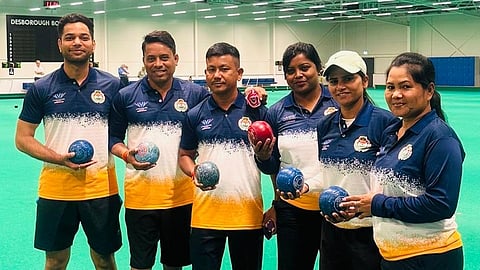

CHENNAI: Confidence. Recognition. Pressure. Expectations.
These are the words the Indian lawn bowl athletes keep going back to as they gear up for their group stage matches in the Glasgow 2026 Commonwealth Games on Thursday.
Four years ago, this was not the case. Until the final stages of the Birmingham 2022 Games, the majority of the country did not know much about the sport. It remained an unknown entity. No Indian had medalled in the sport at CWG before. Some of the athletes, who had been competing in their fourth CWG event, even felt that if they did not have a podium finish, they might not be considered for the next CWG. Every one of the athletes at the event had to rely on a day job to make ends meet apart from representing India at the biggest stage.
It all changed on a historic Wednesday evening in August 2022. The women's team won gold in fours and the men's team won silver in fours, securing the first podiums for the country at the CWG level. Awards, recognition and fame followed. So did the opportunities. Now, five of the eight medallists from 2022 are back again in Glasgow to have a crack at a second medal.
Changing perception
In these four years, their lives have changed in some way or other. For Pinki, a former cricketer turned physical education teacher at Delhi Public School, RK Puram, it gave immense confidence to medal at CWG despite the turmoil in personal life. She was going through a marital separation in the lead-up to the Games in 2022 and now Pinki, an Arjuna awardee, gets recognition at her school. Her students, even the ones who have graduated before settling abroad, come up to her and talk to her. "People used to say my father's name to call me," she told this daily from UK. "Now they recognise my father with my name. I got upgraded at school. Even now, when I am in London, I get calls from my students from India. They say that they want to meet me. You can earn money, but you can't buy someone's respect. You have to earn it yourself."
She is not alone. Dinesh Kumar, another medallist from 2022, is working as a constable with the Jharkhand police department. His job stability has given the family respite while he focuses on winning another medal. Rupa Rani Tirkey, a former kabaddi player and a district sports office in Jamshedpur, credits her family's support for being able to continue the sport. She travels to Ranchi every weekend to train and her husband, an engineer, joins to help her out. Navneet Singh, part of the men's team that won silver, is now a commercial pilot on unpaid leave to compete at this event.
The change, cash rewards and awards have come but not at the scale to change things drastically. Dinesh continues to hope for a promotion in his department. "I have won two medals at the Asian Championships. I have won a Commonwealth medal and a World Cup. This is all because of a good level of confidence. I am hoping and waiting for a promotion," said Dinesh. Navneet, meanwhile, continues to make compromises as he balances his work and sport. He felt that the state governments could do more, but the Bowling Federation of India (BFI) is taking good care of the athletes.
One thing all athletes attest to is the growing popularity at the ground level. Dinesh has been regularly getting messages across social media platforms on how to start playing lawn bowls. Pinki saw a growth at the nationals. "There used to be six-seven teams. Now, 18-19 teams are competing at the nationals. People are getting to know the game. The hard work of so many years has paid off," Pinki said. Rupa Rani has first-hand seen more people turning up at the facilities in Ranchi. "Earlier, we used to take part in fewer games. Now BFI is organising a lot of events for us. There are a lot of new players who are coming. They are asking us to give them time saying, 'we also want to play this type of game,'" Rupa Rani told this daily. At the same time, all four of them also acknowledge the need to improve infrastructure across states so that more people can take up the sport.
Indoor challenge
As things stand, athletes are aware of the expectations to medal again at Glasgow. However, it will be a challenge. This time the event will be played on indoor synthetic surfaces with air conditioning rather than open lawns in Birmingham. The events are also truncated as it is only singles and pairs (there are no triples or fours events). In India, there is only one synthetic surface in Jharkhand where the team has practised. Which is also why they arrived in the UK early and spent time training in England.
"There are a lot of new things that have been added. There is a timer concept you have to put your bowls within 30 seconds. Adjusting to the air conditioning is one thing. This is a newly-laid carpet so it's still fresh on the top and the layering is still there. The speed is very different, here it is fast. In the outdoors, wind, temperature, heat everything changes the green and we adapt to it but here nothing changes it's almost the same throughout the day and night so if we change the temperature of the air conditioning then, yes, that plays a part. But I think that is what sport is all about. It's all about the day as well. If your day is very good and you get a hang of the thing, then you might be the best out of everybody," Navneet explained.
Though the next two weeks pose all kinds of challenges to the lawn bowls team, their mindset remains clear. To get out there on the field and give their best to finish on the podium once again. For, there is no better way to grow the sport than winning after all.

India off to a winning start
The Indian women's pairs side got their campaign off to a winning start on Thursday. Hours before the Opening Ceremony, the duo of Rupa Rani Tirkey (lead) and Pinki (skip) held their nerve in the tie-break to see off the challenge of Malta in a group game.
Tournament format
Unlike Birmingham, Glasgow 2026 uses a set play format across all disciplines in an indoor event. A look...
Singles: Four bowls per player. Played as two sets of seven ends, with a one-end tie-break if sets are level after two sets.
Pairs: Three bowls per player. Played as two sets of five ends, with a one-end tie-break if sets are level after two sets.
Para Pairs (all three disciplines): Three bowls per player. Same format as the open pairs – two sets of five ends, with a one-end tie-break if sets are level.
In sectional play, all ends of every set are completed regardless of the score, because every shot counts for ladder rankings.
In finals play, a set can be called early once the result is mathematically impossible to change.
Venue: SEC Hall 3 within the Scottish Event Campus (SEC), located on the banks of the River Clyde in Glasgow.
Lawn Bowls team
Men’s Singles: Putul Sonowal (Assam)
Men’s Pairs: Navneet Singh – Lead (Delhi), Dinesh Kumar – Skip (Jharkhand)
Reserve Player: Sunil Bahadur (Jharkhand)
Women’s Singles: Nayan Moni Saikia (Assam)
Women’s Pairs: Rupa Rani Tirkey – Lead (Jharkhand), Pinki – Skip (Delhi)
Reserve Player: Reshma Kumari (Jharkhand)