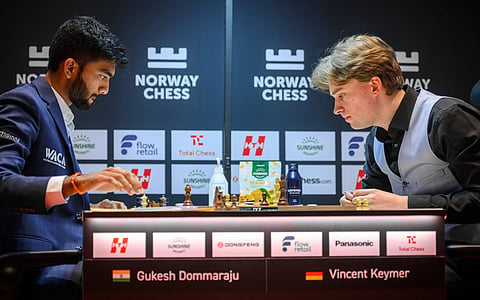

OSLO: For over 165 moves across both the first Classical game and the subsequent Armageddon clash against former Vincent Keymer, D Gukesh fought. First, he fought to not lose. Then, he fought to draw. Finally, he won.
He loves a knife fight on the board and was involved in one for almost five hours at the Deichman Bjorvika in the first round of Norway Chess on Monday. When the Indian teen made his opening d4 with the white pieces, the sky outside was bathed in blue, the waterfront outside shimmering. When it finally finished over five hours later, the sun had set, the tourists had gone home and the venue had almost run out of coffee.
It was a thrilling game from wire to tape, with both players having chances to win. How the 19-year- old saved the draw from a totally lost position — at one point the German was up on the clock while having an advantage of roughly 12 pawns per the engine — even he will wonder. But the reigning Classical world champion will know games like these will act as a booster shot at a time when his confidence has taken a beating. This performance was a peek into the Gukesh at 16, the one who kept finding resources.
This match had everything in it, including the Indian making a draw claim through the 50-move rule (no exchanges, captures or pawn improvement in a 50 move period). But the claim was rejected and the German, fresh from winning the Super Chess Classic in Romania, was handed a two-minute advantage. After the game, Gukesh said 'I was trying my luck'.
It was very clear that he was on fumes, fighting very hard to salvage an endgame where black wins 95 times out of 100 as his opponent had an extra pawn in a queen endgame. But a time scramble — the increments kick in only after 40 moves so players are naturally low on time compared to other meets — reduced this marathon to a sprint in the endgame.
For at least an hour, Keymer's runaway g pawn was stuck at g3, two squares from promotion. But Gukesh kept checking Keymer's king and an uneasy dance followed. With accurate play, Gukesh was totally lost. However, with the clock ticking down, both players traded inaccuracies, mistakes and misses in a wild game.
After 144 moves, Gukesh again claimed a draw under the 50-move rule. This time, the arbiter upheld his claim and both players shook hands. He immediately walked out for a quick debrief with coach Grzegorz Gajewski, the Pole who has been by his side for a few years now. Curiously, both of them had debriefed in an area of the library where there were a few sewing machines and not much else. But they wanted to be away from the media as well as the fans who had come outside the viewing area to catch a glimpse.
When they resumed their combat in the Armageddon — white gets 10 and black seven but white can't draw — the Indian executed a near perfect game as he forced Keymer to resign in 22 moves.
"I knew at some point in that endgame I was probably losing," he later told the official broadcaster. "It was not pleasant. I pushed the whole game and got winning chances. Then, (I) finally lost control." He also admitted his first (draw) claim was 'random'.
When he was finally done with the TV interviews, a visibly exhausted Gukesh still found time to oblige selfie hunters, autograph seekers as well as pose with a plush toy from a fan who had come from the US to meet him.
