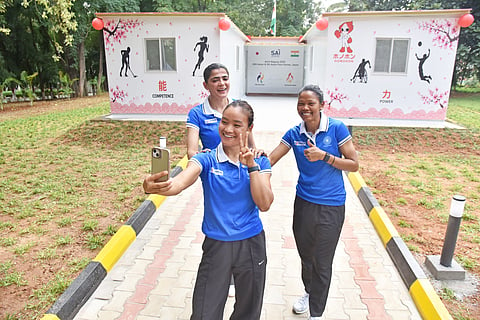

BENGALURU: It seemed like Japan Day at the Sports Authority of India (SAI) centre here. The room, the décor, the cuisine and even the books... the SAI National Centre of Excellence is now a mini-Asian Games venue. Of course, the weather may be much more delightful here as compared to Nagoya. Who says acclimatisation cannot begin at home!
That’s what SAI has been trying to do with their various endeavours in the last eight months or so. A makeshift container-like accommodation was right next to the Athletes Club. There were two sets of bedrooms with soft Japanese music playing in the background. Even the TV screen was displaying everything Japanese – right from the Games at Nagoya to highlights from different Prefectures of the host country. Well, even the books strewn on the centre table were in English like Ikigai: The Japanese Secret to a Long and Happy Life. Acclimatization of mind, body and soul. And of course, stomach too.
Containers and cruise ships have turned into a gigantic theme at this year’s Games. Because of the lack of space in Nagoya, the Games organizers have turned a cruise ship into a Games Village. If there are not enough rooms on ship, athletes would be accommodated in containers that have been turned into rooms. “It’s for the athletes who need to feel at home in Japan,” explained regional director at the NCOE Vishnu Sudhakaran. The SAI official said that the players should not get a shock when they land in Japan and asked to stay in a container.
A few hours later, the dining hall at the NCOE smelled fishy, almost. Raw salmon and tuna, sticky Japanese rice rolled… sushi on the counter, ramen and robatayaki (grill of the region) formed the Japanese counter.

Executive chef Jeyaraj V explained the metamorphosis in the kitchen. It was not something that began yesterday. He and his team of chefs had to take special courses from experts based out of Delhi and Bengaluru. “We wanted to mimic what would be available in Nagoya and it had to be authentic,” he said. Though all kinds of meat and fish are available, there is no beef and pork in the kitchen. “We have to keep certain cultural and religious things in mind,” he said.
Vishnu, who is the head of the NCOE, said that the entire SAI top brass and coaches have been involved in learning Japanese culture and cuisine. He said that this was envisioned two years ago when the SAI learnt that accommodation at the Asian Games will be of a certain type.
“It all started two years ago when we learnt that the accommodation would be different there,” he said. “After proper recce, we started finding out the best way to help our athletes acclimatize with the rooms,” Vishnu said. Though the building is not made up of containers, the whole setting has the feeling.
The SAI engineers and officials improvised and used puff-panels instead of steel or tin. The design was exactly like containers but would have better insulation and would also be more durable. On top of that, it will be cost effective. The Bengaluru centre will keep the structure intact and will be used by athletes’ relatives when they visit the centre.
According to the SAI, the athletes were a bit circumspect about the container ‘therapy’. But now, as the countdown has begun for the Asian Games, players from different sports are hankering for an experience in the container. “We conceptualized it early but started making it in the last couple of months and now with the Asian Games nearing, athletes are asking if they can spend some time in the container-like rooms."
For the menu, procuring ingredients for the cuisine was one of the challenges. “We wanted to have good quality and authentic ingredients and some of them were available in Japanese stores here in Bengaluru,” said the executive chef. “Fishes like salmon and tuna we have to order in advance.”
It was not until around July when they learnt about those athletes who could be part of the Games that they started adding to the daily menu. “We started giving it four-five days a week along with our regular continental and Indian food,” he said. Players too needed to acquire the taste and raw fishes are the ones not too palatable for the athletes. “They are now more accustomed to the food though we had to introduce vegetarian sushis as well,” said the chef.
During dinner, the hall was full. And they seemed to like the cuisine. Over to Japan now