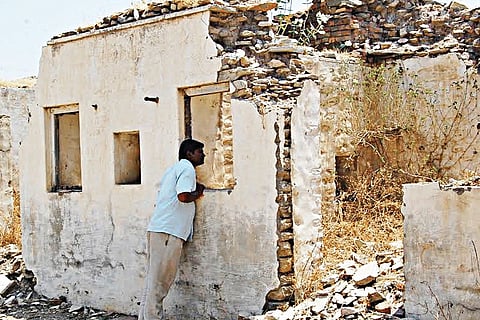

BAGALKOT: Ashok Bajantri was a boy of 15 when his family had to move out of their house on the banks of river Krishna in Bagalkot district of Karnataka. That was in 2000. Between then and 2005, 32 villages were evacuated to make room for overflowing water when the government raised the level of the Almatti dam.
But Ashok’s childhood memories refuse to fade away. They draw him to his old house in Murnal whenever the water level goes down, and his village resurfaces. This is the second year of poor rainfall in this parched region, and the continued drought means many villages fully or partially submerged are now visible.
More than a decade ago, villages such as Murnal, Eerapur, Kesnur, Bannidinni and Aaldinni, once thriving, were evacuated, and people rehabilitated in and around Bagalkot, a hot, dusty northern Karnataka city and district headquarters. Today, a neighbourhood called New Murnal is where most villagers uprooted from Murnal live.
“I got married recently and took my wife there to seek blessings at the village temple that exists to this day,” he said. Ashok and his friends have already made two visits to his house in a week. It is now the property of the Almatti reservoir authorities. His family lived on the main street in a house with four rooms. His parents, sisters and uncles lived as a joint family. When the villages were acquired, the government gave Rs 1.8 lakh as compensation for every acre. Today, the going rate in the region is about Rs 40 lakh. Most landowners now work as labourers in the mills and factories of Bagalkot.
“These villages resurface during summer and remind us of the days when we lived well and had enough to eat,” says Kekappa Mallappa Halligeni, an evacuated farmer.
A decade ago, thousands of families had to migrate as the swirling waters of the Krishna submerged the houses in which they had lived for generations. About 2.9 lakh people were relocated from the banks of Krishna then.
Old Murnal seems like a ghost town to outsiders, but amid the gloom, it brings heart-warming memories to those who once lived there. Manjunath, a resident of Bagalkot now, often walks on the banks of the river to catch a glimpse of his old house. “I can see it only when the waters recede. My parents speak fondly about their days there,” he said.
Murnal is a rallying point for hundreds of people like Manjunath. They are returning to see their abandoned houses, and trudging to places where they had once played and studied. The government school in Old Murnal conducts summer classes for kindergarten children to this day. During the rainy season, it is shut as the waters swamp its compound. Many buildings, as also old coconut groves, show marks that indicate how high the water rises during the monsoon.
A couple of old structures, submerged in the monsoon months, come alive in summer. Among them are a temple and a mutt. A priest visits the temple and offers pooja. But once it starts raining, the expanse is submerged and children walk the distance only to swim, according to Venkatesh, a Bagalkot resident.
Due to weak monsoon last year, the Almatti dam did not fill up to its capacity. Hence parts of some of these villages were above water throughout the year.
