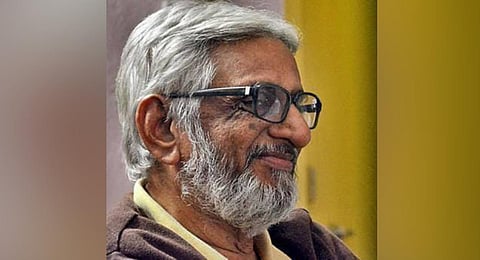

VISAKHAPATNAM / RAJAMAHENDRAVARAM: Asserting that there is an absolute need to question the government’s actions, noted environmentalist and Telugu writer Thallavajhula Patanjali Sastry called on fellow environmental activists to have the courage to question the government on violations of laws. “Being soft never works,” he said and added that people have a ‘divine’ right over the natural resources.
The 78-year-old has been honoured with the Sahitya Akademi Award-2023 for his collection of short stories titled ‘Rameshwaram Kaakulu Mari Konni Kathalu’. He will be presented with the award and a cash prize of Rs 1 lakh in New Delhi on March 12, 2024. Governor S Abdul Nazeer congratulated the writer on the achievement.
Currently settled in Vadrevu Nagar in Rajamahendravaram, he expressed joy on receiving the prestigious award. “It is a great day in my life,” he said.Speaking to TNIE, he shared his father’s philosophy which he always follows: “Never preach in writing, remain true to oneself, and avoid a dichotomy between inner values and external expressions.”
Born at Pithapuram in erstwhile East Godavari district on May 14, 1945, Sastry studied post-graduation in history and archeology from SV University, Tirupati. He completed his Ph.D in Archeology (Temple Architecture) from Deccan College, Pune. He has written a number of stories, four novels and six plays.
After working as a lecturer in an aided college in Amalapuram, he took a voluntary retirement and joined Bhagavatula Charitable Trust in Yalamanchili, Visakhapatnam district. He has participated and organised several rural development programmes.
He had fought a 12-year-long battle to restore Kolleru fishing pond. He had filed a Public Interest Litigation (PIL) to save 1,500 acres of mangroves in Krishna district and won the case. He had taken up an intense campaign to protest setting up of ship breaking units in Kakinada. Sastry was involved in the conservation of birds at Uppalapadu in Guntur and campaigned extensively for the conservation of wetlands in Godavari districts.He has also been a member on the AP Coastal Zone Management Committee and AP pollution control board.
Stating that environmental protection extends beyond common practices like planting trees, managing plastic-use, and combating air pollution in today’s world, he explained, “The essence of environmental conservation lies in safeguarding vital resource bases such as topsoil, water bodies, groundwater, and green cover. Despite being educated, a fundamental challenge persists in the way people perceive and approach environmental conservation.”
Expressing concern over the current scenario, Sastry said, “Environmental concerns persist as there is an annual loss of millions of tonnes of topsoil and acres of green cover, alongside evident groundwater depletion. Authorities often view environment as a hindrance to development. If there are no environmental foundations for development, it will not last long. Understanding the necessity and purpose of development is crucial-the why, what, where, which, and how.”
He observed that the biggest violator of environment is often the government, especially through its projects that breach environmental laws. “Environmentalists must have the courage to question such violations and should not be labelled as anti-establishment for doing so,” he said.
Citing the Tamil Nadu floods, he noted, “In the name of development, wetlands and ponds were destroyed, leading to the floods in TN. Similar conditions are often observed in Hyderabad. The oil spill in TN, penetrating Pulicat Lake backwaters, illustrates the gravity of the situation. It is in such conditions that the question of development arises.”
