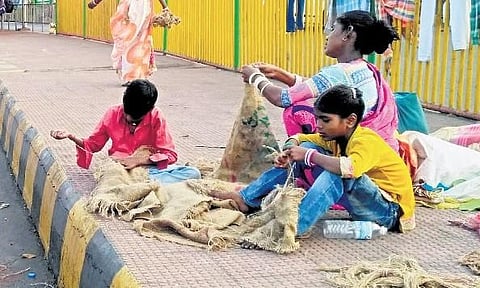

VISAKHAPATNAM: A 14-year-old boy was reunited with his sister two days after he was abandoned by his family in Visakhapatnam. Another 13-year-old was rescued from the Anandapuram area in the city and was forced into child labour due to the tragic loss of both his parents. The child was, subsequently, transferred to a government rescue home.
These are the stories of child labourers who have been rescued by the district labour department during its ongoing month-long drive in the city. While some children engage in labour-intensive activities to earn quick bucks during their summer vacation, others resort to child labour owing to the financial constraints of their families.
The deputy commissioner of the labour department, Suneetha, said, “We are on a mission to eradicate child labour from Visakhapatnam by 2025. Children are meant to be in school, enjoy their childhood, and achieve things in life rather than taking up odd jobs at a very young age. Not just the labour department but also other line departments, including education, health, police, women, child welfare, etc., are working on this mission.”
Of the 40 children rescued so far, 29 were from non-hazardous occupations, one from hazardous occupation, and 10 were dwelling on the streets. Addressing this issue, Suneetha stated that most of the children shared during the counselling sessions that they engaged in work to pass the time during their summer vacation. “Their parents explained that these tasks were merely casual activities to keep them occupied, as they believed that the children might be lured into negative influences if left ideal,” she said. “Our approach to rescue these children extends beyond providing shelter.
We ensure comprehensive care by conducting medical examinations, reviewing their past academic records, providing counselling, and taking appropriate actions accordingly. We discovered a migrant child labourer in Vizag living without his parents. This child undertook various odd jobs to fulfil his daily needs. With a translator’s assistance, we conversed with the boy and discovered that he was a school dropout. Subsequently, we took initiative to enrol him back into a school. Every child has different needs, and our approach towards them is based on their circumstances,” Suneetha elaborated.
While most of the 40 children were employed at small businesses near their homes, they were counselled along with their parents. Two of them were shifted to rescue homes.
The areas where most child labourers are found in Visakhapatnam are Anandapuram, Thagarapuvalasa, Padmanabham Mandal, and the industrial areas. Often we see them working at brick kilns, toll gates, small-scale industries, railway tracks near Kancharapalem and engaging in roadside vending at highways and signals. As these children endure harsh conditions and are robbed of their innocence as they shoulder adult responsibilities at a tender age, their education, health, and overall development are often compromised, perpetuating a cycle of poverty. “Child labour is closely linked to migrant workers and encompasses both the child’s and their family’s responsibility. As long as migration, despair, and joblessness persist, child labour will continue,” the Association for Urban and Tribal Development (AUTD) secretary Pragada Vasu opined.
He stated that there is an urgent need for more shelters and resources for vulnerable individuals. “Local governing bodies and the state government should prioritise these individuals. They can build hostels with basic amenities and charge a minimal amount for maintenance, while these people can start to earn by themselves in some way or another. NGOs can only thrive with strong government support,” he explained.
